Most Wanted: The Phishing Kits and Techniques Getting Past Security Controls
Every phishing attack has to get past email security, web filtering, and safe browsing before it reaches an employee. Some kits manage that far more often than others, and those are the kits that security teams need to know about. At Push Security, we measure this as breakthrough rate: The share of attacks that get past email security, web gateways, and safe browsing to reach the user. How an
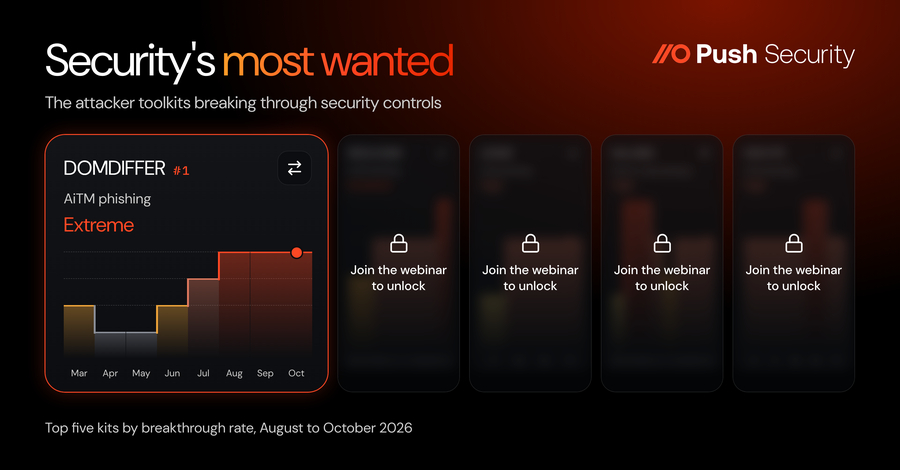
Every phishing attack must evade email security, web filtering, and safe browsing measures before reaching a target employee. Security teams must prioritize kits with higher breakthrough rates—higher shares of attacks that bypass these security controls. Push Security defines breakthrough rate as the percentage of attacks that reach users after passing through email security, web gateways, and safe browsing.
The organization measures breakthrough rate to identify the most effective kits. Browser-based attacks start with a lure, and each control in the attack's path scrutinizes only a portion of the attack. Breakthrough rate counts attacks, not attempts, presenting a different perspective on upstream data. A kit with a high breakthrough rate indicates that upstream controls are ineffective against it.
Conversely, a low count in email or proxy logs does not necessarily imply that the kit is rare, as it may bypass those controls without leaving traces. Push Security's upcoming webinar will reveal the five kits with the highest breakthrough rates. This section provides an early glimpse into the top kit. Between August and October 2026, one kit consistently ranked first by breakthrough rate each month.
DOMDIFFER, an AiTM phishing kit targeting corporate Google and Microsoft accounts, broke through security controls 2-4 times more often than the second-ranked kit each month. DOMDIFFER targets users by creating fake calendar event notifications, often related to voicemail, which lure victims into visiting a malicious page. This page mimics Google's sign-in page, passing a bot check to avoid detection by scanners.
On the surface, the attack appears standard: a lure, a bot check gate, and a sign-in page. However, what makes DOMDIFFER particularly effective lies in its sophisticated technique—DOM mirroring. AiTM kits relay a sign-in using one of four methods: reverse proxy, replica page, pixel streaming, or DOM mirroring. DOM mirroring involves the attacker's browser conducting the real sign-in and relaying the page's structure (the DOM) to the victim's browser, which recreates a functional copy.
This method allows the kit to send genuine browser signals and handle new sign-in steps without needing additional code. Other kits, such as the main criminal pixel-streaming kit Laurseraph and authorization-attack-focused kits like BlueKit and PhantomDOM, have also adopted DOM mirroring, making it the newest and fastest-growing technique in 2026.
The webinar on December 2 will delve into DOMDIFFER and the other four top kits, explaining their inner workings and the evasion techniques that enable them to bypass security controls more effectively than other kits.
Rewritten by urgent.news; may contain errors — check the original.
Source: thehackernews.com