Higher Productivity Should Translate Into Better Compensation
Prime Minister Narendra Modi's criticism of India Inc. at the recent FICCI convention was unusually sharp. Why have companies failed to raise wages and employment despite substantial corporate tax concessions and rising profits? Earlier, Economic Affairs Secretary Anuradha Thakur had raised similar concerns. Chief Economic Adviser V. Anantha Nageswaran has been warning about the divergence…
Prime Minister Narendra Modi recently expressed frustration with India Inc. at a FICCI convention, questioning why businesses have not increased wages and employment despite tax breaks and surging profits. Concerns about the disparity between profits and wages have been voiced by Economic Affairs Secretary Anuradha Thakur and Chief Economic Adviser V. Anantha Nageswaran for the past two years.
This disparity raises questions about economic growth distribution, workers' livelihoods, and private industry's investment reluctance.
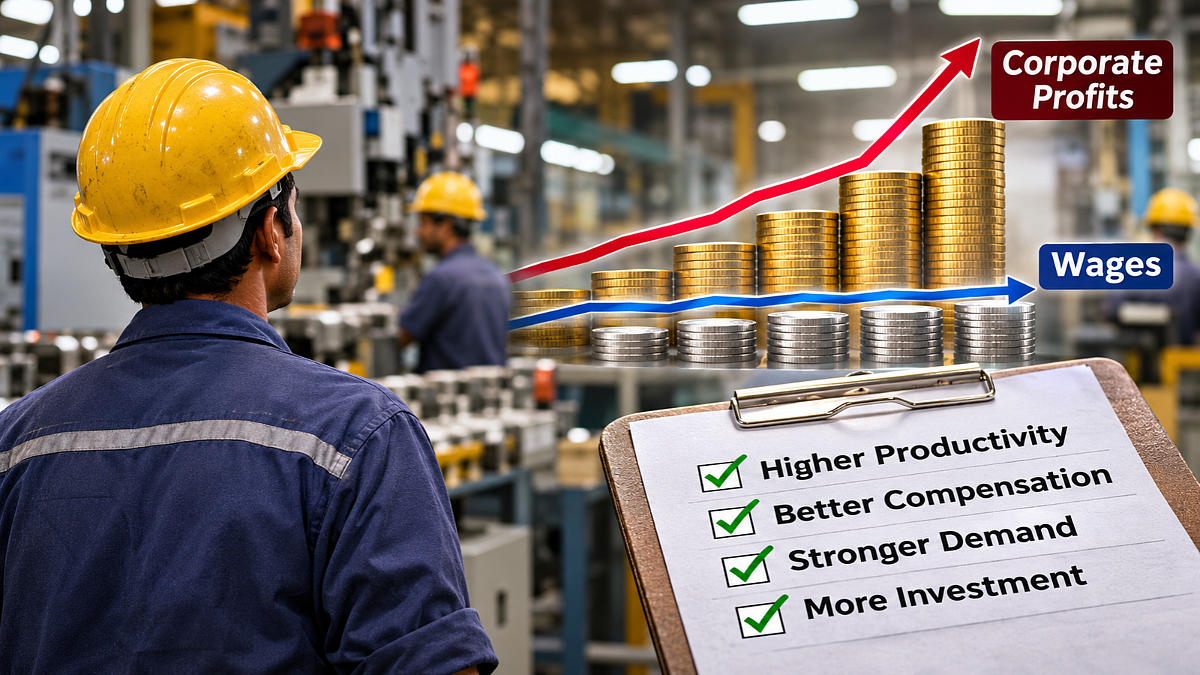
Nifty 500 companies' profits surged from ₹6.5 lakh crore in 2020-21 to ₹18.1 lakh crore in 2025-26, marking a 23% annual growth rate and now constituting 5.2% of the GDP, the highest ever. Despite a 2019 corporate tax cut, private investment has not followed expectations. Meanwhile, factory workers' wages in 2024-25 averaged ₹2.28 lakh, or ₹19,000 monthly, growing by just 0.7% after adjusting for inflation. Real wages have increased by less than 1% annually over the past five years.
In contrast, supervisory and managerial employees earn over six times more than factory workers. While the largest listed companies do not represent the entire industry, thousands of smaller firms face challenges due to thin margins, uncertain orders, and limited financing. This highlights an unequal distribution of gains within the industry.
Private sector investment hesitance stems from a lack of sufficient demand for products. Companies will only expand if they are confident their production will sell profitably. With slow-growing household incomes, companies may prefer debt repayment, financial asset accumulation, or dividend distribution over new investments. This creates a cycle where weak consumption discourages investment, limiting job creation and perpetuating stagnant wages.
The persistent gap between profits and wages can be attributed to labor's weakened bargaining power. India's industry increasingly relies on contract workers, outsourcing, and casual employment, leading to significant wage disparities based on employment status. The decline of trade unions and the high number of job seekers have further reduced workers' negotiating power.
Violent labor disputes, such as the 2012 Maruti Suzuki incident in Manesar, demonstrate the tension and grievances arising from limited worker bargaining power.
New forms of employment, like platform companies, contribute to this imbalance. Gig workers, despite being crucial to the economy, are often misclassified as independent contractors, denying them social security benefits and fair wages. While new labor codes recognize gig workers, effective implementation remains a challenge. Ultimately, government policy plays a crucial role in fostering productive employment, addressing regulatory barriers, ensuring fair minimum wages, and promoting social security.
Rewritten by urgent.news; may contain errors — check the original.
Source: freepressjournal.in