Handel: KI-Agenten entfachen Machtkampf um die Herrschaft im E-Commerce
Große KI-Modelle wollen den Onlinehändlern den direkten Kundenkontakt wegnehmen – und damit einen wichtigen Teil des Geschäfts. Doch neue Technologien bieten Händlern wieder bessere Chancen.
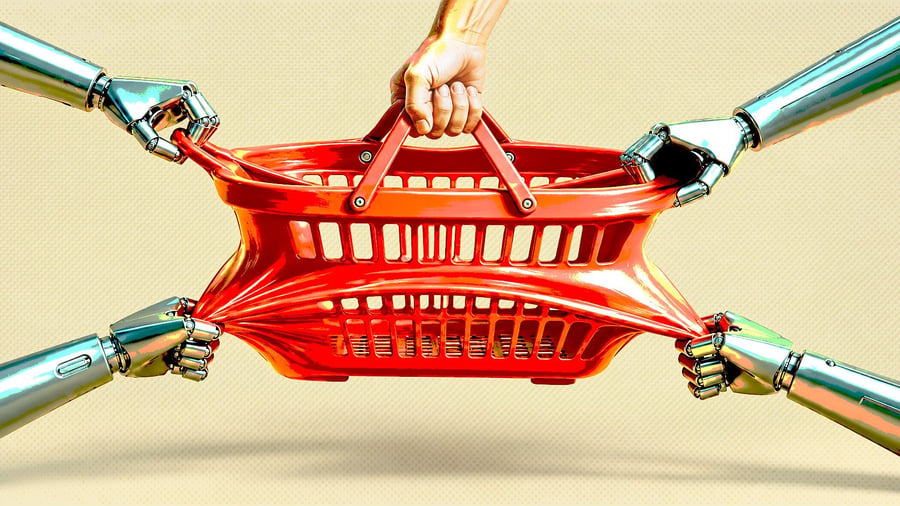
Amazon has sparked a power struggle in the e-commerce world as it blocks Meta's AI agent Muse from accessing its platform, while simultaneously deploying its own shopping agent within rival stores. The company's US shopping app, "Buy for me," suggests products outside of Amazon's marketplace. Amazon retains direct customer contact, earning roughly one billion dollars in additional sales per month from its shopping assistant. However, other retailers have not been consulted.
With Christmas shopping kicking off and Black Friday around the corner, customers are increasingly relying on AI agents. Artificial intelligence is no longer merely a tool but the gateway to the shopping experience, according to retail expert Tobias Göbbel from Accenture. Göbbel explains that AI can completely take over the search engine and the merchant in the purchasing process.
The discomfort among retailers is significant, as Guido Hoepfner, CEO of Rewe Digital, warns on the trade congress in Berlin. "A huge wave is coming," he says. "The big question is who will have customer access and shape the shopping experience in the future?"
A representative Accenture survey of German consumers indicates that 60% of respondents believe generative AI will influence more than half of their Christmas purchases. Among regular AI users, one in two trust an AI agent trained on their personal needs for shopping more than their own judgment. Around 29% would even let the AI make purchase decisions, and 9% would allow it to complete purchases autonomously, including payment.
Other surveys show similar results. According to a Yougov survey commissioned by Team-Bank, 24% of Germans have already tested the help of AI agents in online shopping beyond discount days; the figure is even 42% among those under 30.
Large retailers are building their own AI assistants for the holiday season. Amazon combined AI agent Rufus with language assistant Alexa to add more functions and rename it "Alexa for Shopping." Otto, which took several months to get its AI assistant running, is now seeing it used thousands of times daily. Zalando aims to go a step further by having a KI agent also shop outside its own platform, starting with a partnership with the furniture retailer Westwing.
"Zalando Extended" will handle the purchasing process on behalf of the customer without the customer having to leave the Zalando app – starting next year.
While customers may ultimately trust the retailers' own AI agents for their Christmas purchases, the H&Rs with established expertise could potentially outperform the tech giants' AI agents. Accenture survey results show that 27% of respondents would choose a KI agent from a major tech company first for their holiday shopping, but the H&Rs' AI agents come in a close second at 22%.
Many customers have experienced that a major fashion retailer's AI may have more expertise in fashion matters than ChatGPT or Gemini. For now, there is a coexistence between the AI solutions of tech giants and e-commerce companies, with many retailers benefiting from bringing customers from chatbots like ChatGPT, Gemini, or Claude.
However, this cannot continue indefinitely. Göbbel warns that if the entire sale, including payment, happens within the agent system, retailers lose contact with the customer. OpenAI had already introduced a checkout function in ChatGPT, but due to problems with retailers and low customer acceptance, they temporarily put it on hold.
Nonetheless, such solutions are likely to become widespread soon as more people use personal AI agents like Instinct, ChatGPT Dots, or Meta's Muse, which run continuously in the background on computers or smartphones.
Rewritten by urgent.news; may contain errors — check the original.
Source: handelsblatt.com