Bumblebee-Sized Robot Uses Its Own "Brain" to Fly, Opening the Door to Advanced Robotics
Learn how engineers are developing tiny robots that can fly on their own and what that could mean for future robotics.
In 2025, Myanmar endured a catastrophic 7.7-magnitude earthquake that caused thousands of casualties and inflicted billions of dollars worth of damage to infrastructure. As part of the rescue efforts, Myanmar deployed cyborg cockroaches equipped with infrared cameras to crawl through the rubble and locate trapped survivors. Engineers are now focusing on developing artificial insects that could perform similar missions in the future.
Recently, researchers from MIT made a significant breakthrough in creating an artificial bumblebee capable of autonomous sensing and controlled flight. The microrobot, weighing less than a paperclip, has the ability to hover, follow a predetermined path, and land on a flower. Kevin Chen, an associate professor at MIT and co-author of the study, stated that this represents the first demonstration of an aerial microrobot with sensory and computational autonomy.
Currently, the microrobot is connected to an offboard power source via wire tethers, but this design suggests that artificial flying insects could be a reality outside the lab. Chen, who heads the Soft and Micro Robotics Laboratory at MIT's Research Laboratory of Electronics, believes that small-scale robots have unique advantages for tasks like pollination or industrial surveillance, where larger robots are impractical.
MIT's team has been working on microrobots inspired by bumblebees for a decade. Last year, they unveiled a microrobot with speed, dexterity, and robustness comparable to its biological counterpart. However, it was unable to carry the necessary electronics for navigation. After refining the design, the team achieved a lift-to-weight ratio of 1.9 and successfully integrated an electronics package weighing just 244 milligrams.
They did this by increasing the size of the artificial muscles by 50 percent and enhancing the net lift force by 46 percent.
Incorporating sensing technology, the team placed sensors within the electronics package and programmed a microcontroller unit to determine the microrobot's orientation, angular velocity, and position. They found that continuously estimating the microrobot's position provided comparable accuracy to using onboard cameras for flight.
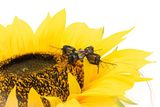
Demonstrations show that the microrobot can hover at various heights, navigate from point A to B, and even weave around plants before landing on a sunflower. The researchers aim to further reduce the microrobot's power consumption, potentially adding features like a camera to help avoid obstacles and identify objects while airborne.
With further advancements, these miniature flying robots could contribute to search and rescue efforts, monitor crop health, and assist in pollinating plants in areas where natural pollinator populations have declined.
Rewritten by urgent.news; may contain errors — check the original.
Source: discovermagazine.com