AI Helps Three Powerful Supercomputers Simulate The Milky Way In Extraordinary Detail
Researchers have combined the power of three supercomputers to simulate the Milky Way in extraordinary detail. The effort also incorporated a new AI surrogate model of supernovae. The simulation employed 5.4 trillion particles, which is about 10,000 times more than other state-of-the-art simulations.
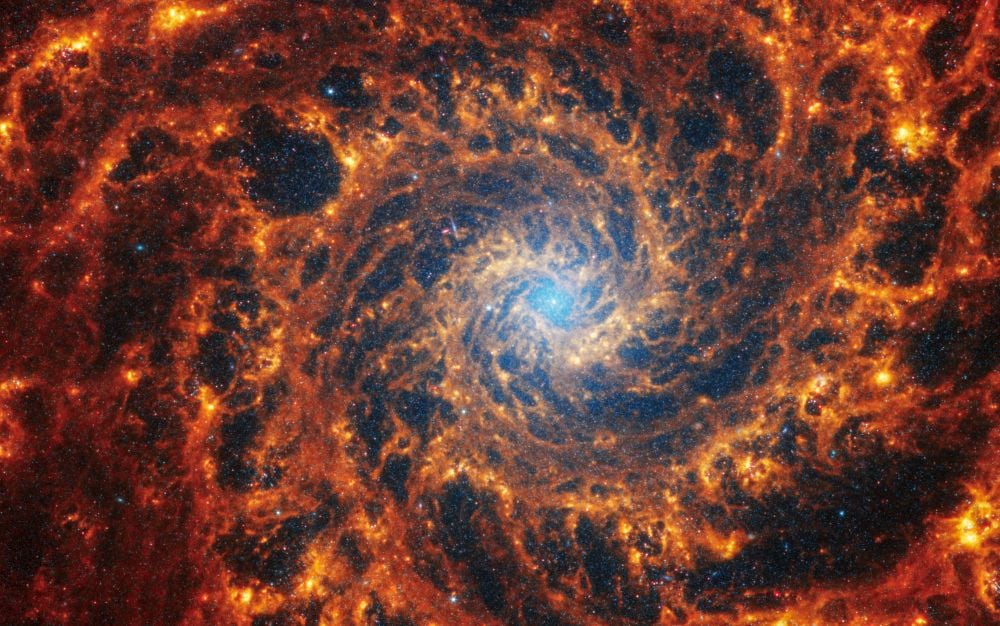
In a groundbreaking achievement for astronomy, astronomers have managed to simulate the Milky Way galaxy with unprecedented detail using three powerful supercomputers and artificial intelligence (AI) technology. The researchers harnessed the collective power of Aurora, Frontier, and JUPITER supercomputers, each running the same software on different hardware including Intel, NVIDIA, and AMD GPUs and CPUs.
This collaboration allowed them to simulate the galaxy at a resolution where individual stars, each with a mass of one solar mass, are represented.
Previously, the smallest level of detail in simulations was clusters of stars with the mass of about 100 Suns. The newly achieved simulation, described in a paper titled "Architecture-Agnostic Exascale Star-by-Star Simulation of Our Galaxy," utilizes 5.4 trillion particles, which is about 10,000 times more than the most advanced simulations currently available.
The authors, led by Keiya Hirashima from RIKEN in Japan, expect that as computational power continues to increase, even more detailed simulations will become possible. However, they emphasize that achieving such detail for a galaxy the size of the Milky Way is not straightforward.
The complexity of the simulation lies in the need for extremely short time steps to accurately represent the behavior of individual stars and the dynamics of gas. This requirement greatly increases the amount of calculation needed. To address this challenge, the researchers developed an AI model called PHEASANT, which predicts how gas around supernova explosions evolves. By using this model, the simulation was able to skip over many small time steps, significantly reducing the computational resources required.
The PHEASANT model, developed by postdoctoral researcher Keiya Hirashima, proved crucial in allowing the larger simulation to efficiently represent the effects of supernovae, which are complex events requiring their own detailed simulations with very small time steps. Hirashima's model predicts the gas distribution after 100,000 years, allowing the simulation to use longer time steps rather than calculating every small step directly.
This achievement enables scientists to gain a better understanding of the Milky Way and other galaxies by accurately representing the behavior of gas and stars. Stars, which form, drift, and evolve, play a critical role in the overall structure and evolution of galaxies. As Hirashima notes, this detailed simulation offers insights into how individual stars, like our Sun, contribute to the Milky Way's structure through various physical processes.
Rewritten by urgent.news; may contain errors — check the original.
Source: universetoday.com