Opinion · Business
A commitment to strengthen our Constitution, writes PM Narendra Modi
"For crores of Indians, including me, the Constitution of India is an inseparable part of our life journeys"
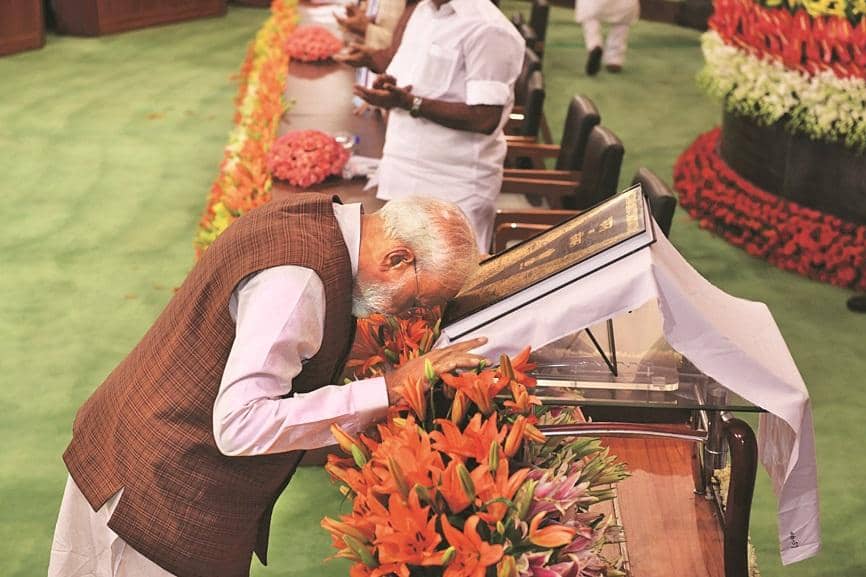
On November 26, 1949, India's Constituent Assembly adopted the nation's Constitution, and today, we honor the vision of Dr Rajendra Prasad, Babasaheb Ambedkar and all others who helped bring this historic document to life. The greatness of these pioneers lay in their ability to blend Bharat's rich traditions with modern ideas to create a Constitution that would resonate with the diverse population of the country.
Recognizing that a nation as diverse as India requires a Constitution that extends beyond the confines of Parliament and courts, our government decided to observe November 26 as Constitution Day. This initiative aims to deepen the connection between the Constitution and the collective consciousness of the people, particularly the youth.
To millions of Indians, the Constitution is an integral part of their lives. Growing up in humble circumstances, I am filled with gratitude for the Constitution, which has enabled a child from a modest background to serve the world's largest democracy. The Constitution has made it possible for one's circumstances of birth no longer to define the limits of their future.
India's Constitution is often described as a "social document" by experts like Granville Austin. The pursuit of social and economic justice is woven throughout the document. For example, the Government's Pradhan Mantri Awas Yojana has helped impoverished families move from simple homes to better accommodations, while the Ujjwala Yojana has freed women from the burdens of cooking in smoke-filled kitchens.
Ayushman Bharat has enabled low-income families to access quality healthcare without the fear of financial hardship, thus translating social justice into reality.
Recent government amendments reflect the same vision for the Constitution. The 101st Amendment introduced the Goods and Services Tax, the 102nd Amendment granted constitutional status to the National Commission for Backward Classes, and the 103rd Amendment provided reservation for the Economically Weaker Sections. This is the first time since 1950 that the Constitution has been available in all 22 languages listed in the Eighth Schedule.
Additionally, the Bharatiya Nyaya Sanhita has shifted the criminal justice system from a punishment-focused approach to one centered on justice.
Over the past decade, this government has emphasized the role of citizens, known as kartavya, drawing on India's civilizational emphasis on responsibilities. This spirit has been reflected in movements such as Swachh Bharat and efforts for water conservation and environmental protection. However, history has seen times when those entrusted with upholding the Constitution have chosen to weaken it, as seen in the First Amendment in 1951 and the 42nd Amendment during the Emergency.
Repeated misuse of Article 356 to dismiss elected state governments is another troubling aspect of Indian political history. Some leaders have used this power nearly 100 times, while one former Prime Minister imposed it 50 times. The makers of the Constitution hoped it would be implemented in full across India, but Articles 370 and 35A prevented this in Jammu and Kashmir, leading to the disenfranchisement of certain communities and women. In 2019, this injustice was rectified.
The Naxalite movement has used violence to deny constitutional rights to the poorest people, particularly tribal groups. The elimination of Naxalism is heartening because it allows the most vulnerable to exercise their rights without fear. However, one of the major opposition parties wants to reduce OBC reservation and introduce reservations for Muslims, which goes against the constitutional values set by founders like Ambedkar.
In addition, a proposed legislation to ensure adequate representation for women in legislative bodies was blocked by the same opposition party.
As we work towards a Viksit Bharat by 2047, the guiding principles of "India First" and "kartavya" (citizen duties) should be our sources of strength. By upholding the Constitution as our foundation, we can secure a bright future for generations to come.
Rewritten by urgent.news; may contain errors — check the original.
Sources: economictimes.indiatimes.com · business-standard.com
This story
This is one outlet's version. Read the fullest account.
- Our firm resolve to strengthen the Constitution economictimes.indiatimes.com