When Stars Collide: Astronomers Have Spotted a First-of-Its-Kind Stellar Merger
A quick, violent, super-bright end as two stars become one The post When Stars Collide: Astronomers Have Spotted a First-of-Its-Kind Stellar Merger appeared first on Nautilus .
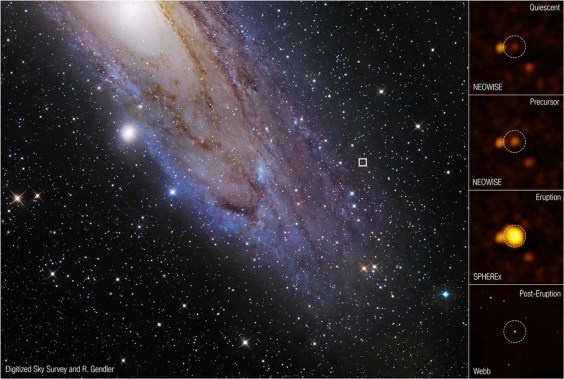
In the vast expanse of the Andromeda galaxy, approximately 2.5 million light-years from our own Milky Way, an extraordinary celestial event has been captured by astronomers. Two stars, one a super-giant around seven times the mass of our sun and the other a significantly smaller star with only a tenth of the sun's mass, have merged in a phenomenon known as common envelope evolution (CEE).
This merger, the first of its kind to be observed, resulted in a super-bright eruption that was detected by the James Webb Space Telescope.
The merger process, from the smaller star being drawn into the larger one to being completely engulfed, lasted only seven years - an astonishingly short time span compared to the centuries typically associated with such events. The newly formed single star, named Bao, may have been rejuvenated by the influx of extra stellar material. This remarkable event has been documented in a study published in Nature, following extensive observations that began in 2023.
Study author Nadia Blagorodnova expressed her astonishment at the rapidity of the outburst, saying, "We thought it would take centuries for an outburst to happen, and then one day it erupted." Common envelope evolution is characterized by the two stars sharing parts of their gas cloud with each other. In this case, when the smaller star's envelope came into contact with its larger neighbor, it lost orbital energy and was pulled in, leading to the merger.
While CEE scenarios typically result in mergers, they can also lead to other transformations such as black holes and supernovae explosions. This particular merger, however, has provided astronomers with a unique opportunity to study the process in detail. As study author Kishalay De notes, "These surveys are opening up completely new avenues to study dying stars and perhaps even discover new phenomena we haven't seen before."
Rewritten by urgent.news; may contain errors — check the original.
Source: nautil.us