Voyager’s cosmic map of Earth’s location: Cute, but wrong
Here in late 2026, an incredible milestone has been reached: the Voyager 1 spacecraft — humanity’s most distant spacecraft from Earth — has finally passed a distance of one light-day from us. Along with its twin, Voyager 2, these two spacecraft have left the confines of the Solar System and now traverse interstellar space, freely floating through the interstellar medium. Eventually, their…
In 2026, a significant event occurred: Voyager 1, humanity's furthest spacecraft, surpassed a distance of one light-day from Earth. Accompanying its twin, Voyager 2, these spacecraft now navigate through interstellar space, drifting in the interstellar medium. Eventually, their radioactive power sources will decay, rendering them non-functional.
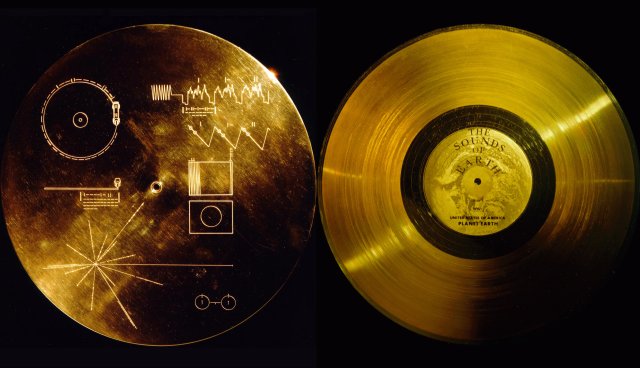
However, there remains a possibility that an extraterrestrial civilization could discover one or both of these ancient relics in the distant future. On board each Voyager is the Voyager golden record, a treasure trove of Earth's information, designed to communicate with any potential discoverers.
The golden record features various images, sounds, and songs, all meant to introduce Earth and humanity to any extraterrestrial beings fortunate enough to encounter it. The record’s cover showcases a map of Earth's position in the galaxy, determined through the mapping of 14 radio-loud pulsars. Although this method was innovative for its time, we now realize it is fundamentally flawed.
The map does not offer a clear path for anyone who finds it to pinpoint Earth's location, making it an endearing, yet misguided artifact from our early days in space exploration.
Rewritten by urgent.news; may contain errors — check the original.
Source: bigthink.com