The Event Horizon Telescope Views the Dynamics and Geometry of a Black Hole Jet in Extreme Detailelescope
Observations by the Event Horizon Telescope Collaboration resolved the innermost region of the blazar 3C 279 powerful jet emitted in unprecedented detail.
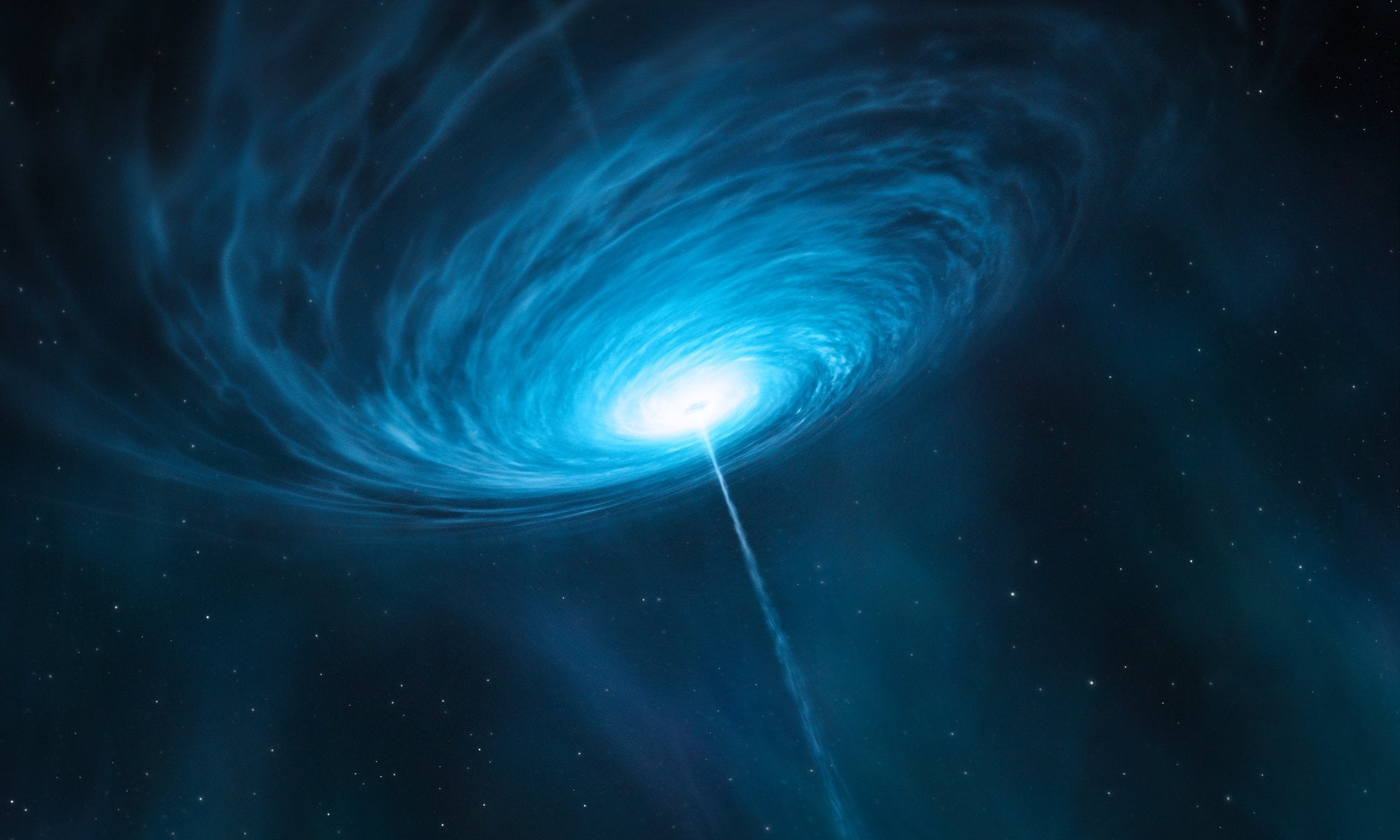
The Event Horizon Telescope (EHT), a global alliance of astronomers and radio observatories, has unveiled stunning new images of a black hole jet in unprecedented detail. This is the third such image produced by the EHT in recent years, following the first picture of a black hole in 2019 and the first of the Milky Way's central black hole in 2022.
The 2024-2026 campaign focused on the 3C 279 blazar, a galaxy with a supermassive black hole at its core that ejects a high-speed jet. The EHT's observations revealed the jet's shape and motion at scales smaller than a single parsec, the distance light travels in a parsec. This bending towards Earth-based instruments helps explain why certain features in the jet appear to move more slowly across the sky while remaining visible.
Three new telescopes - the Kitt Peak Observatory in Arizona, the Northern Extended Millimeter Array (NOEMA) in the French Alps, and the Greenland Telescope - were crucial for this campaign. These telescopes added key intermediate baselines that enhanced the EHT's coverage, particularly for intermediate-scale structures within the jet.
The team used various imaging software to process the massive EHT data, employing different assumptions about the images to confirm their findings. This multi-wavelength analysis also provided insights into the jet's behavior over time, suggesting a possible mechanism for its acceleration.
Rewritten by urgent.news; may contain errors — check the original.
Source: universetoday.com