Mujeres marchan en Argentina contra la violencia de género; acusan al Gobierno de Milei de desfinanciar políticas de protección
La movilización tuvo la participación de personas de todas la edades que portaban pancartas que incluían al presidente Milei quien se expresó en contra de la "ideología de género"
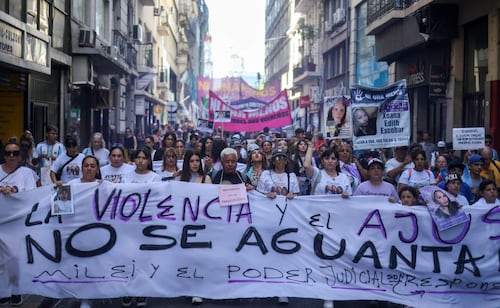
More than 200 people marched through the streets of Buenos Aires on Wednesday, marking the International Day for the Elimination of Violence against Women. They demanded that the Argentine government stop cutting funds for awareness and protection programs for victims. The main demonstration, organized by various feminist and LGBTQ+ groups, wound its way from the city's court complex to the National Congress, where protesters held signs criticizing President Javier Milei, who has previously spoken out against what he calls a "gender ideology."
The march was peaceful and contrasted sharply with the heavy police presence that typically surrounds the National Congress on Wednesdays, when pensioners demand budget cuts to their pensions are met with force. Myriam Narbona, a protester, told EFE that the day's events brought together several popular struggles: "Here are the pensioners asking you to get rid of this government, and the women who are mobilizing because we are being killed all over the country."
Narbona added: "Even if these governments are malevolent, we will continue to fight and it will cost them to push through their policies, because we will be here in the streets. We don't want more girls to be killed, or more adult women, or for the transgender killings and hate crimes against the LGBTQ+ community to continue." Protesters carried signs like "The repressive state is a male rapist," and Seyla Riera, an activist with La Neurona Rebelde, explained their motivation: "In a country governed by neofascism under Milei, hateful speeches and crimes of hate, femicides, are advancing, so this day takes on great relevance because we must continue fighting for rights we thought we had already won."
October 2025 saw the highest number of femicides in the past decade, but they are not the only reason for the protest. The government also faces criticism for failing to protect women who report violence or for not respecting the child support payments they are entitled to. The Observatory of Gender Violence, a group that tracks such incidents, recorded 222 femicides between January and November 2025, compared to 191 in the same period last year, marking an increase of more than 16%.
Other incidents documented included 32 cases of vicarious violence, nine travestiges, trans femicides, and ten suicide threats. The Milei government does not count femicides; it is the Supreme Court of Argentina that does, which recorded 200 victims in 2025, 12.3% fewer than in 2024. This figure is disputed by feminist organizations, who argue that it only includes cases that have gone through the judicial system.
Rewritten by urgent.news; may contain errors — check the original.
Source: eluniversal.com.mx