Ant Group Open-Sources LingSante: Why Open Medical AI Matters
Explore Ant Group’s open-source LingSante medical AI models, featuring on-device image understanding, long-context clinical reasoning, and open evaluation.
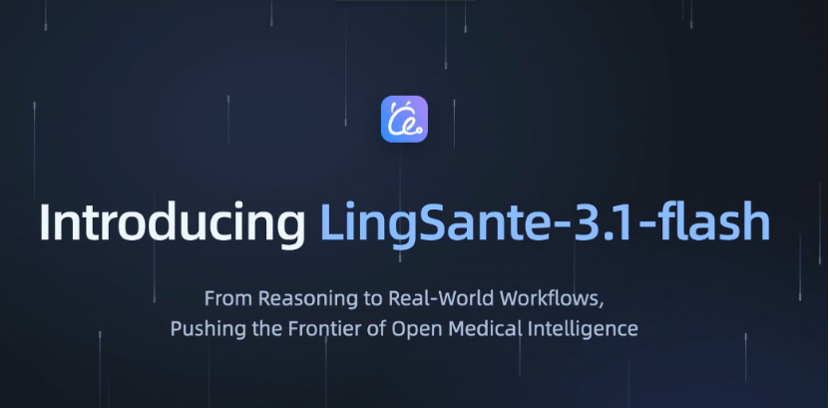
Ant Group, the tech company behind Alipay, has released a family of open-source medical AI models called LingSante. Unlike most medical AI, which is confined to paywalls and private APIs, LingSante aims to democratize access to advanced AI in healthcare. The family currently consists of two core models, LingSante-3.1-air-VL and LingSante-3.1-flash, each designed for distinct applications.
LingSante-3.1-air-VL is a lightweight model, weighing in at 124 billion parameters but with only 5.5 billion active during runtime. This makes it suitable for on-device deployment, allowing for privacy-friendly and low-latency healthcare AI applications. Air-VL can analyze medical images, skin conditions, diet advice, and medical reports, offering developers the ability to build healthcare AI systems that respect patient privacy and provide quick responses.
On the other hand, LingSante-3.1-flash is a more powerful model with 560 billion total parameters, 25 billion of which are active. It boasts a 1 million-token context window, making it capable of handling complex, multi-step clinical workflows. This model is particularly useful for tasks such as evidence-based retrieval, long-horizon clinical agents, and patient history analysis.
To ensure the reliability and trustworthiness of these models, Ant Group has developed InclusionMed, an open evaluation platform in collaboration with 29 institutions, including Stanford, Harvard, and Peking Union Medical College. InclusionMed's inaugural rankings have placed LingSante-3.1-flash at the top among all open-source medical models, providing a valuable benchmark for developers and researchers.
The release of LingSante signals a significant step towards open medical AI, offering developers access to multimodal models, long-context reasoning, and an open evaluation platform. While these advancements are promising, it is crucial for builders to validate the models with their own patient populations, maintain clinician oversight, and adhere to local regulations.
The release of LingSante opens up new possibilities for privacy-preserving, low-latency healthcare AI and invites the global health tech community to contribute to and benefit from open-source medical AI research.
Rewritten by urgent.news; may contain errors — check the original.
Source: hackernoon.com
