An Unwavering Commitment To Strengthen Our Constitution
On November 26, 1949, the Constituent Assembly adopted our Constitution. Today, we remember Dr Rajendra Prasad, Dr Babasaheb Ambedkar, and every member of the Constituent Assembly. Their greatness lay in drawing extensively from the rich traditions and civilisational wisdom of Bharat while framing a modern constitution. For a nation as diverse as Bharat, with its numerous faiths, languages,…
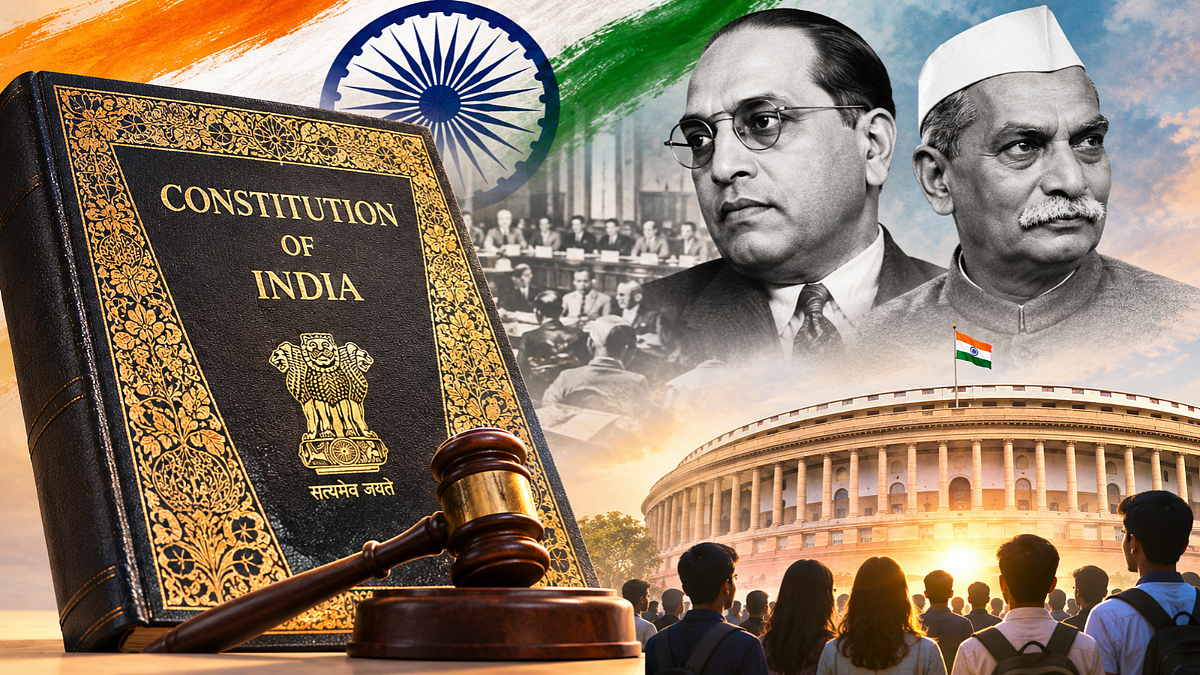
On November 26, 1949, the Constituent Assembly ratified India's Constitution. Today, we honor Dr Rajendra Prasad, Dr Babasaheb Ambedkar, and every assembly member. Their genius stemmed from drawing inspiration from Bharat's rich traditions and civilizational wisdom while crafting a modern constitution. For a country as diverse as India, with its myriad faiths, languages, customs, and schools of thought, it is crucial that the Constitution resonate deeply with the nation's collective consciousness, not merely within the halls of Parliament and the courts.
Our aim has been to deepen this connection with the public, particularly the youth, and fortify the spirit of unity vital for India's promising future. Consequently, over a decade ago, our government designated November 26 as Constitution Day. To millions of Indians, including myself, the Constitution of India is an integral part of our existence.
Whenever I reflect on my childhood, the humble beginnings and hardships I encountered, I am overwhelmed with gratitude towards our Constitution. That a child from a modest background, devoid of any birthright or privilege, could later bear the responsibility of serving the world's largest democracy attests to the extraordinary nature of our Constitution.
It is thanks to our Constitution that one's birthplace no longer dictates the scope of their future. In our modest way, we have endeavored to repay this debt of gratitude by fortifying our Constitution. Constitutional scholar Granville Austin once referred to our Constitution as "above all, a social document". The pursuit of social and economic justice permeates its very essence.
Therefore, what could be more gratifying than striving towards the realization of this cherished vision of the Constitution's framers? Social Justice Manifestation Various government initiatives exemplify the constitutional promise of social justice. PM Awas Yojana, transforming families from thatched huts to permanent homes, embodies the Constitution's promise of dignity.
Ujjwala Yojana, liberating mothers from the perils of indoor pollution, advances the ideals of equality and well-being. Ayushman Bharat, facilitating access to quality healthcare for impoverished families without the fear of financial ruin, renders social justice a lived reality. MUDRA and PM-SVANidhi, offering collateral-free credit to small entrepreneurs and street vendors, materialize economic justice.
Digital platforms and UPI, transcending barriers and making once-exclusive opportunities accessible to all citizens, embody the constitutional ideal of inclusivity. The list of amendments we have enacted could be scrutinized through the same lens. The 101st Amendment introduced GST, a long-overdue reform. The 102nd Amendment bestowed constitutional status upon the National Commission for Backward Classes, fulfilling a long-standing aspiration of marginalized communities.
The 103rd Amendment garnered widespread social acceptance by providing reservations to economically disadvantaged individuals from communities outside the existing reservation framework. For the first time since 1950, an updated version of our Constitution is now available in all 22 languages of the Eighth Schedule, bringing it closer to the people.
Even after our Constitution's inception in 1950, we remained bound by the colonial penal code from the 1860s. With the Bharatiya Nyaya Sanhita, we sought to fundamentally alter our criminal justice system, shifting from the colonial focus on punishment to a citizen-centric pursuit of justice. Over the past decade, we have emphasized kartavya, the duties of a citizen.
Our civilization has always underscored the responsibilities accompanying every societal role. The spirit of kartavya has manifested in numerous mass movements, from Swachh Bharat to water conservation and environmental protection. However, there is another reality that I must acknowledge. There have been instances in our history when those entrusted with upholding the Constitution chose to undermine it.
Ironically, these individuals had the opportunity to govern India for five decades. This year marks the 75th anniversary of the First Amendment of 1951, when an unelected government, using its majority in the Provisional Parliament, restricted fundamental freedoms, timed barely months before India's first general election to manipulate the electoral process and suppress public dissent.
Similarly, 50 years have passed since the 42nd Amendment during the Emergency, which curtailed judicial review and fundamentally altered institutional power dynamics. I urge young citizens to study the 38th and 39th Amendments to understand the consequences of power-hungry and anti-constitutional leadership. The repeated misuse of Article 356 to dismiss elected state governments is another troubling chapter.
One party has the dubious record of imposing Article 356 nearly a hundred times, and one former prime minister has achieved this feat five times. The Constitution's framers envisioned its implementation in letter and spirit across India. Yet, for over 70 years, Articles 370 and 35A denied the full Constitution's implementation in Jammu and Kashmir, violating the rights of SC, ST, OBCs, and women. Only in 2019 did this historical injustice come to an end.
Rewritten by urgent.news; may contain errors — check the original.
Source: freepressjournal.in