Africa is importing financial regulations that weren’t designed for its reality
African fintech builders have spent the last decade engineering around the continent’s actual economic terrain: mobile money, informal retail, fragmented payment rails, and expensive cross-border corridors. Yet when African regulators confront these products, they rarely start by studying how risk behaves on the ground. Instead, they reach for rulebooks written for mature Western markets and ask…
Sub-Saharan Africa faces challenges in adopting financial regulations that fit its unique economic landscape. Fintech developers have built solutions around mobile money, informal retail, fragmented payment systems and high cross-border costs. However, regulators often rely on rulebooks designed for mature Western markets without first studying how risk manifests locally. This importing of regulatory frameworks before testing local conditions hinders financial integration.
While core financial standards like anti-money laundering, stability and consumer protection are non-negotiable, they are insufficient substitutes for empirical data about African market dynamics. Ghanaian analyst Bright Simons explains that governance breaks down when policymaking, implementation and learning are disconnected. Crypto transactions illustrate the consequences of delayed regulatory learning.
Nigeria's 2021 ban on crypto services was later lifted and replaced with guidelines, yet this approach allowed adoption to occur through unregulated peer-to-peer channels. The IMF reported in 2026 that initial restrictions failed to stop crypto adoption, only shifting activity to unmonitored channels.
Ghana's restrictions on formal financial institutions as virtual asset providers were lifted when firms began operating without regulation. Kenya enacted a Virtual Asset Service Providers Act in 2025 after initially warning against crypto use. South Africa licensed crypto providers after recognizing them as financial products in 2022.
Each nation's approach led to the same conclusion: regulators failed to observe markets before attempting to oversee them. Temporary bans buy time but without immediate supervised testing, authorities outsource market intelligence to operators who have already navigated regulatory limbo.
Regulatory sandboxes aim to repair this feedback loop by allowing firms to test products in a controlled environment while regulators evaluate the effectiveness of their rules. Properly designed, sandboxes enable learning and rule rewriting based on real-world evidence. In contrast to Ghana's recent sandbox where compliance was counted rather than analyzed, the UK's Financial Conduct Authority treats sandboxes as platforms for iterative policy discovery.
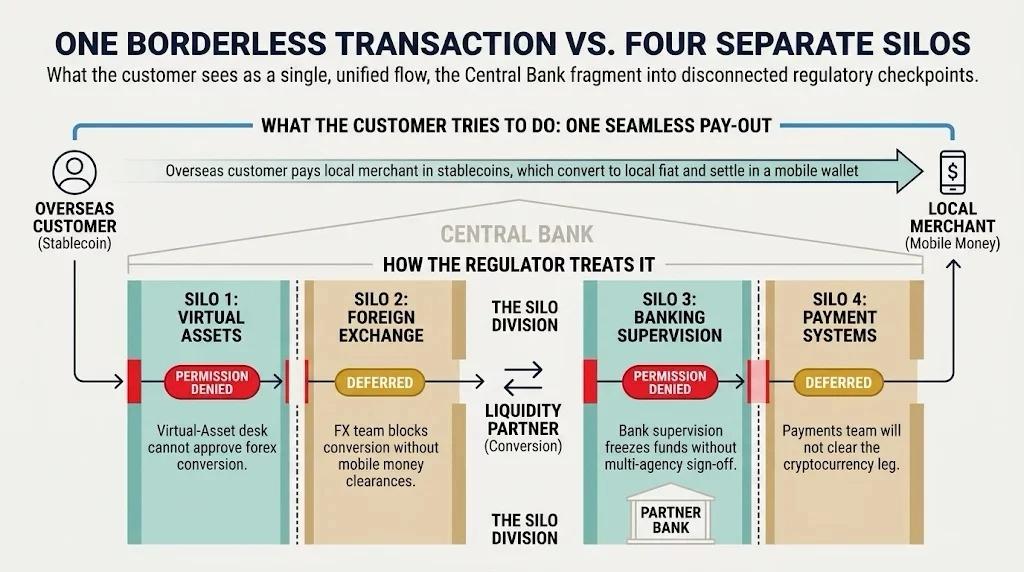
In 2026, the Bank of Ghana admitted firms to a virtual-asset sandbox explicitly designed to test proposed rules, marking a step toward genuine learning. However, for this approach to succeed, regulators must share findings broadly rather than keeping them confined to bilateral agreements. Bridging regulatory oversight across multiple jurisdictions is essential when fintechs operate across borders, such as a platform enabling overseas customers to pay local merchants in stablecoins.
In reality, this single transaction touches four different regulatory areas, requiring coordination among various departments and agencies.
Rewritten by urgent.news; may contain errors — check the original.
Source: myjoyonline.com