Long Horizon UIP in Emerging Markets
Paper just out, by Rebucci, Toraman, Valente, and Capirone: Uncovered interest parity (UIP) tends to hold at long horizons for advanced-economy currencies. Whether it holds in emerging markets remains a more open question. We show it does not, and that sovereign credit risk can explain the failure. Using monthly zero-coupon local-currency yield curves for all […]
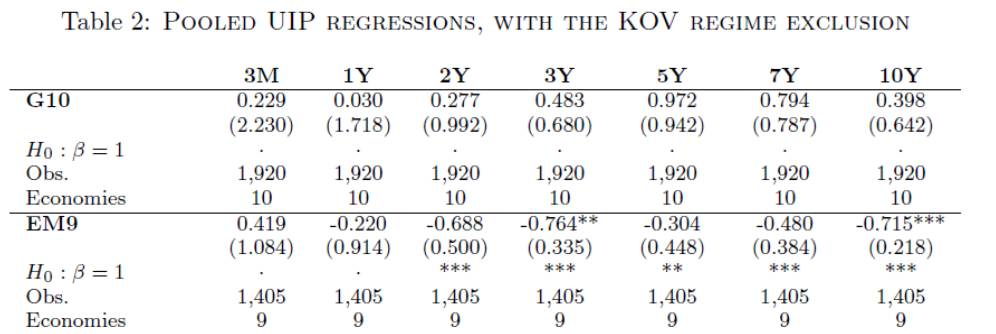
A recent study by Rebucci, Toraman, Valente, and Capirone reveals that uncovered interest parity (UIP) does not hold over long periods for currencies in emerging markets, unlike advanced economies. The researchers used monthly zero-coupon local-currency yield curves for emerging market currencies from 2000 to 2025 and discovered that the slope of long-horizon UIP regressions is notably below one at a five-year maturity for these currencies.
Nevertheless, when sovereign credit spreads are included in the regression, the slope increases to values similar to one for floating currencies from emerging markets, making it statistically insignificant. This effect is most pronounced for currencies with high levels of credit risk variability. The study employs a no-arbitrage asset pricing framework to guide the regression specifications and interpretation of the findings.
Rewritten by urgent.news; may contain errors — check the original.
Source: econbrowser.com