Haushaltsdebatte: Wie die Opposition die Haushaltspläne der Regierung zerreißt
Die Haushaltswoche im Bundestag ist speziell. In diesem Jahr ganz besonders. Zum Auftakt müssen Kanzler und Vizekanzler einstecken.
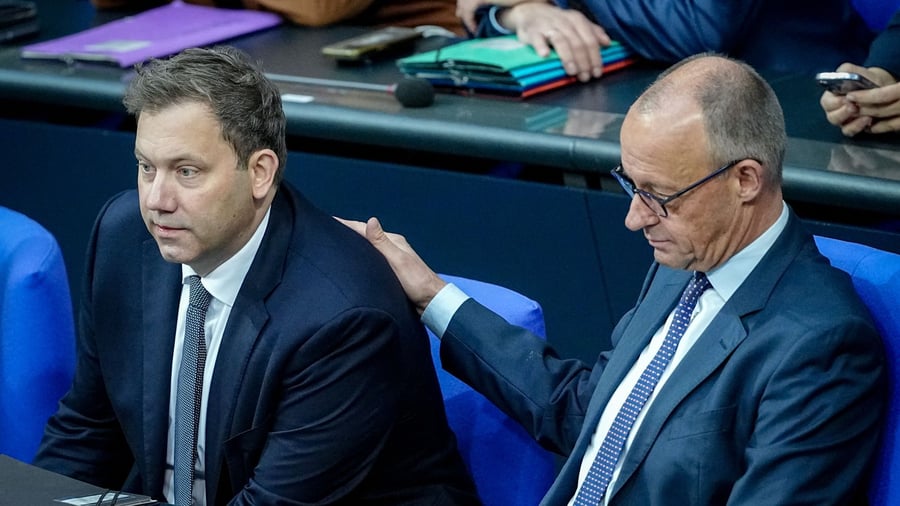
The 2027 federal budget is a high-stakes operation this year: as Finance Minister Lars Klingbeil (SPD) takes the podium to defend his department's spending, he is not yet finished. A last-minute compromise on cutting the consumer and business electricity tax must still be incorporated. Opposition parties are furious, even the SPD's budget director rebukes his government for disrespecting Parliament.
Vise Chancellor Klingbeil defends the government, acknowledging the chaos. But they managed to close a 34 billion euro funding gap and invest in the future. The opposition sees it differently: the future generation will pay the bill for the black-red government's actions. A special Bundestag week kicks off with budget experts' speeches in the parliament: for four days, everything revolves around money.
The parliamentarians decide how much money the government led by Chancellor Friedrich Merz (CDU) can spend on in the coming year. On Friday afternoon, the budget for 2027 will be decided. A special debate will take place tomorrow morning during the discussions about the chancellor's budget. The so-called general debate is opened by the AfD opposition leader, followed by the response from the chancellor.
It's not just about money, but about the whole government policy. The core budget should allow the Bund to spend around 560 billion euros next year, the most ever in a year. Over a third goes into the welfare and social budget, from which the government deducts funds for pensions insurance. Cuts planned by the government for housing benefit and child support were withdrawn in negotiations.
For 2028, these could come back to the table. Unions' vice Mathias Middelberg announced the need to cut again, and then they could "even spare social welfare". Another focus of the budget is defense: spending is to rise to nearly 140 billion euros next year - reaching a peak since the end of the Cold War. Ukraine receives 12 billion euros in support against Russian aggression.
What's in it for consumers? Initially, the federal government planned some reforms that would make life more expensive, including taxes on sugary drinks and plastic packaging. They were initially rejected by parliamentarians, as well as the social cuts. Entitlements are supposed to come through a reform of the income tax, benefiting mainly small and medium income earners.
They include a higher child allowance and an increase in the basic exemption threshold, from which income tax is paid. Everyone else pays more. How it's funded taxes and other revenue are not enough to cover the planned expenditures. One-third of every euro is financed through credit. The Union and SPD want to take on nearly 123 billion euros in debt within the core budget alone.
This is in addition to multi-billion loans from special funds for infrastructure and the Bundeswehr, totaling around 210 billion euros in new debt. Every minute, the Bund takes on more than 400,000 euros in debt, calculated AfD budget director Michael Espendiller. "Every small family house, day and night, and that even on Sundays and at Christmas."
Link budget director Dietmar Bartsch spoke of a "debt orgy", Green budget director Sebastian Schäfer accused the federal government: "What you present here is not a budget, it's a shabby wall of ideas without a foundation." What's special this year is that normally the budget is decided after a long session of the responsible budget committee, the decision in the Bundestag then is just a formality.
This year, however, the Union and SPD negotiated in a coalition committee until late at night, agreeing to cut the electricity tax at least for all citizens and businesses to the European minimum next year. This is supposed to make electricity cheaper. It costs the Bund about 5.4 billion euros, which will be incorporated into the budget retroactively on Wednesday.
The tax cut is to be funded by funds that are not expected to be recovered from the promotion of renewable energy. Because the higher the electricity price, the less the state has to pay for those generating electricity from solar and wind power. Financing a tax cut with a prognosis of the development of electricity prices is not only dangerous for the opposition.
"Mr. Chancellor, that's a high-risk bet that the electricity prices remain high," SPD budget director Thorsten Rudolph said to Merz. "A bet where the budget bears the loss risk." Anyone who wanted to finance the tax cut seriously would have to "finally tackle the climate-damaging subsidies".
Rewritten by urgent.news; may contain errors — check the original.
Source: handelsblatt.com