Analysis: Political fractures, market woes test investment climate
The Indonesia Stock Exchange has struggled to recover in November, after the Jakarta Composite Index (JCI) fell from 5,863.78 on Oct. 15 to 5,304.76 on Nov. 17. The decline reflects mounting concerns on several fronts, from MSCI’s proposed reclassification of Indonesia’s equity market and political uncertainty following Gibran Rakabuming Raka’s resignation as vice president to growing tensions…
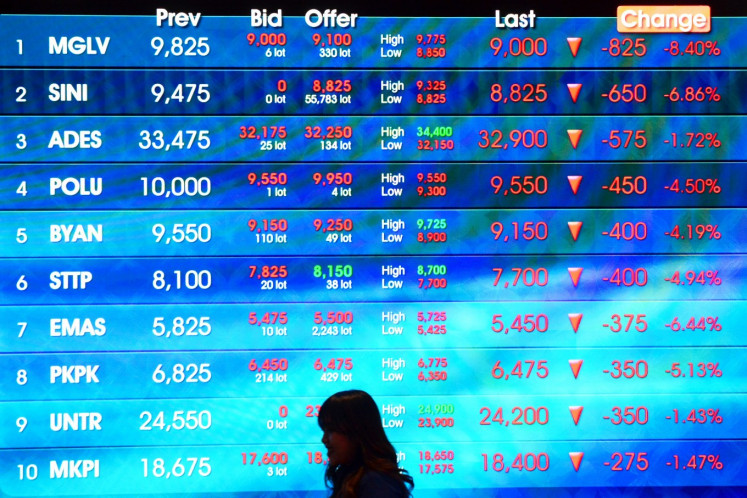
In November, the Indonesia Stock Exchange faced challenges in regaining momentum, with the Jakarta Composite Index plummeting from 5,863.78 on October 15 to 5,304.76 on November 17. This decline stems from a variety of concerns, including MSCI's proposed reclassification of Indonesia's equity market, political uncertainty stemming from the resignation of Vice President Gibran Rakabuming Raka, and growing tensions surrounding foreign investments.
Gibran's departure from the vice presidency, while ending tensions over his legitimacy, has also ignited questions about the future of the political alliance between President Prabowo Subianto and Joko "Jokowi" Widodo. This alliance is now under strain, potentially leading to increased unpredictability in the administration's policy preferences and fiscal obligations, which could further cloud investment forecasts and expectations of policy stability.
Moreover, political instability is just one facet of a larger investment hurdle. The Prabowo administration must ensure that investment efforts translate into productive economic activity and improved employment prospects. Despite attempts to draw in manufacturing investment and augment industrial capacity, informal employment continues to dominate the workforce.
This persistent issue raises questions about the efficiency of how economic growth and new investments are converting into better employment quality, productivity, and household income.
Protests at BYD’s manufacturing facility in Subang, West Java, exemplify the friction that can arise between attracting foreign investment and meeting local employment aspirations. Demonstrations in late October, which have persisted, called for a larger workforce from surrounding areas, alleging that the factory had not sufficiently employed locals.
BYD, employing nearly 6,000 workers, recounted recruitment difficulties due to a lack of candidates with prior automotive manufacturing experience, leading them to recruit more extensively across West Java. The company also noted that around 90 percent of its workforce is Indonesian, with 80 percent originating from West Java. This scenario underscores a broader challenge: a disconnect between the local labor pool and the specialized skills needed by industrial investments.
Automotive manufacturing demands specific technical skills and industrial experience, which might be more prevalent in established manufacturing hubs and urban areas than in Subang. Thus, mandating local hires who may not meet operational needs could affect production efficiency, while neglecting skill development could leave surrounding communities unbenefited from incoming investments.
Rewritten by urgent.news; may contain errors — check the original.
Source: thejakartapost.com