2 white dwarfs and a red dwarf: Astronomers discover unusual star system near Earth
The solar system, home to our Sun and eight planets, is a well-known structure. However, numerous star systems exist in the galaxy, featuring stars bound together by gravity in various configurations. Some systems consist of large, hot stars orbiting smaller, cooler stars; others include double stars with planets orbiting them; and some systems emit X-rays, with one star shedding material while the other consumes it. A notable example is Alpha Centauri, a triple-star system situated about 4.37 light-years from Earth.
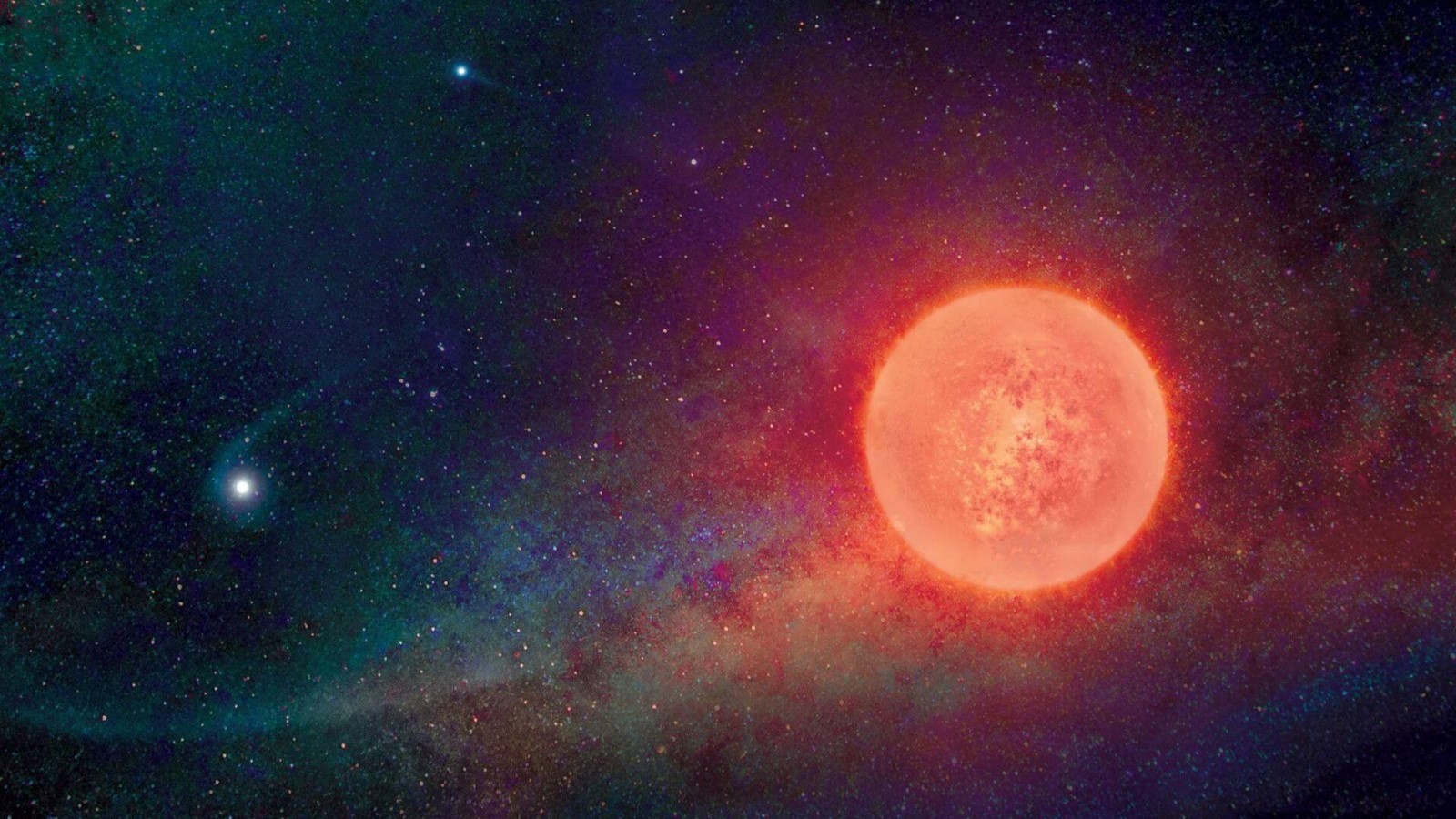
Recently, astronomers have discovered another unusual triple-star system approximately 28 light-years away from Earth, named Welopō'ai. This system comprises a faint red dwarf and two white dwarfs. The finding was made by researchers at the Trottier Institute for Research on Exoplanets at the Université de Montréal while they were searching for planets orbiting the red dwarf.
While the red dwarf and one white dwarf were previously identified, the discovery of a second, previously unnoticed white dwarf added to the system's surprise factor.
Étienne Artigau, who led the discovery, explained that they were searching for planets and instead stumbled upon this extraordinary triple-star system. This system, located just 28 light-years away, has no similar counterparts within at least 100 light-years. Artigau referred to the system as Welopō'ai, a combination of two Hawaiian words meaning 'a path of family traits.'
The unique configuration of the Welopō'ai system has left astronomers baffled. Co-author Patrick Dufour, an expert in white dwarfs, admitted that there is no clear explanation for how this system came to exist. This discovery raises questions about the history of the three objects and their interactions over time.
White dwarfs are the remnants of stars similar in mass to our Sun. When such a star reaches the end of its life, it sheds its outer layers, which expand into space, while its core contracts to become an inert white dwarf, roughly the size of Earth but with a mass between half and two-thirds of a solar mass. The Welopō'ai system was once a triple-star system with two sun-like stars and the red dwarf.
Over time, the two sun-like stars experienced stellar death, while their companion red dwarf remains due to its low mass, which allows it to have a longer lifespan since it does not consume its core hydrogen as rapidly.
Artigau emphasized that discoveries like Welopō'ai highlight the fact that our cosmic neighborhood still holds remarkable surprises, even when searching for planets. The unexpected nature of these findings reminds us of the vast unknowns that still exist in our universe.
Rewritten by urgent.news; may contain errors — check the original.
Source: indianexpress.com