1st-ever detection of a dying star's 'final nuclear heartbeat' challenges what we know about our sun's eventual death
Astronomers have caught a rare transitional phase at the end of a star's life, a fossilized remnant of stellar death throes, that could change our picture of the sun's final days.
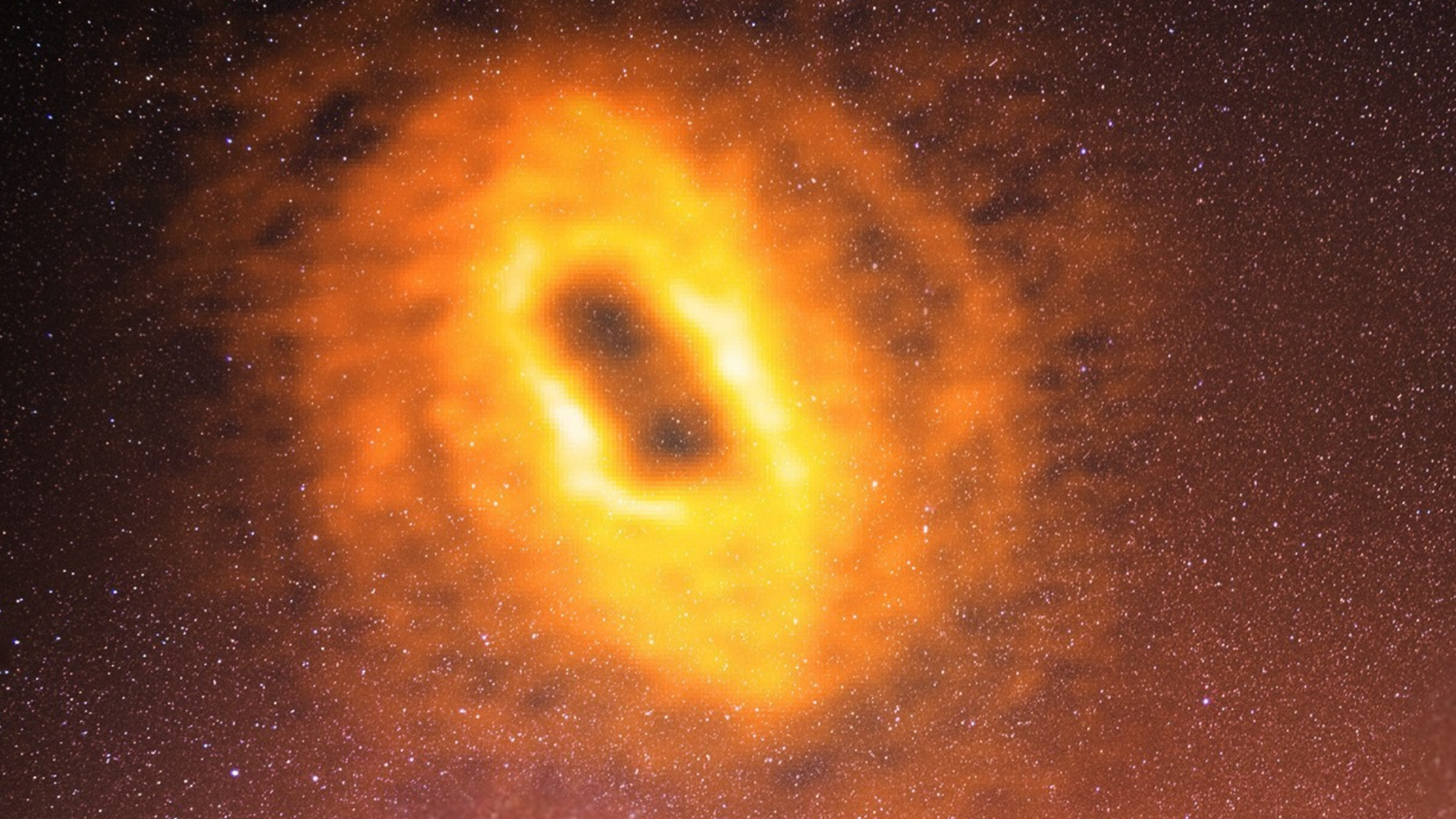
The sun, our closest star, is not eternal and will eventually meet its demise, although this event will occur billions of years from now. Unlike massive stars that explode in supernovas, sun-like stars, including our own, undergo a quieter death. In the past, scientists believed the sun's final stages would unfold smoothly, but recent observations from the Atacama Large Millimeter/submillimeter Array (ALMA) telescope have unveiled a different picture.
These groundbreaking findings, led by NASA Jet Propulsion Lab researcher Raghvendra Sahai, reveal a snapshot of the star's final nuclear heartbeat, frozen in time.
Sun-like stars reach the end of their lives when they exhaust their core hydrogen reserves, halting the fusion process and causing the star to lose its outward pressure. Consequently, the star's core contracts, giving rise to a red giant phase. During this phase, the star's outer layers swell and eventually disperse, leaving behind a white dwarf and a surrounding planetary nebula shell.
Throughout this transformation, the star periodically experiences thermal pulses, causing bursts of nuclear activity and flinging stellar material into space. Sahai's team focused ALMA on a star named IRAS 06530-0213, situated approximately 12,000 light-years away in the constellation Monoceros. The telescope captured a giant ring of gas resembling a fossilized record of the star's last thermonuclear flare-up.
This gas shell, shaped like an hourglass, is currently in the process of forming a planetary nebula.
The team determined that the gas shell surrounding IRAS 06530-0213 is about half a light-year wide and was expelled around 6,500 years ago. This marks the first direct evidence of the star's last thermal pulse before it transitions into the final phase of its life. Furthermore, the team observed a lumpy, spiral-shaped distribution of gas filaments around the dying star, possibly indicating the presence of an unseen companion orbiting it.
Intriguingly, the ALMA observations also revealed an unexpected abundance of heavy elements, such as carbon, oxygen, and nitrogen, around IRAS 06530-0213. While this finding contradicts current models of stellar element mixing, similar signatures have been observed in other odd stellar objects with violent nuclear fusion activity.
Another puzzling aspect of the ALMA observations is the absence of a disk-like structure around IRAS 06530-0213, which has typically been associated with companion stars and the formation of hourglass shapes. The team suggests that this may be due to the existence of a brief disk during a high-speed jet phase that subsequently faded away.
Sahai concluded that the complex story of dying stars, such as IRAS 06530-0213, is far more intricate than previously imagined, with hidden companions shaping their ejected material into intricate, bipolar, or multipolar forms. The team's findings, published in The Astrophysical Journal, provide a real-time glimpse into the dramatic death throes of a sun-like star, challenging our understanding of stellar evolution.
Rewritten by urgent.news; may contain errors — check the original.
Source: space.com