Wasserstoff: So sollen Brennstoffzellen leichter werden
Kleinflugzeuge und Drohnen müssen möglichst leicht sein. Eine neuartige Brennstoffzelle könnte künftig dabei helfen, Gewicht einzusparen.
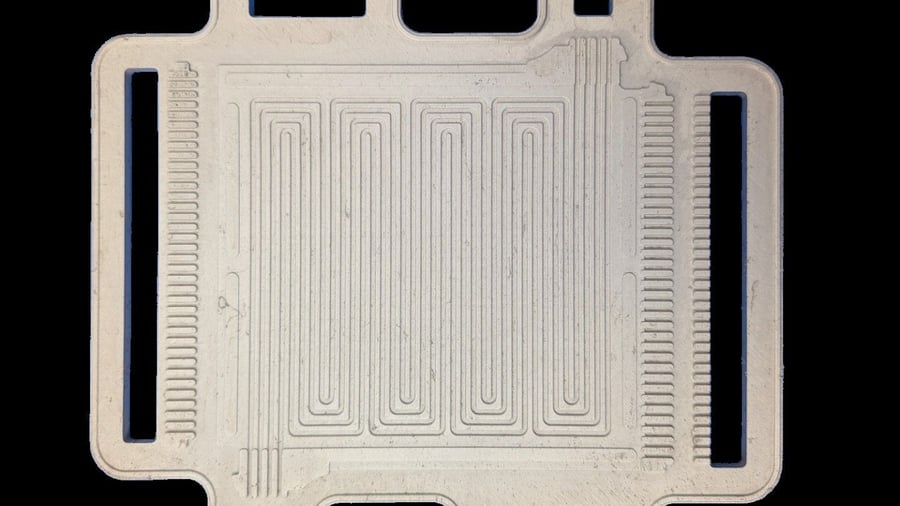
In Chemnitz, researchers from the Fraunhofer Institute for Tool Engineering and Forming Technology (IWU) are working on making fuel cell technology lighter for use in aircraft. They are exploring the use of carbon fiber reinforced plastic for this purpose, particularly in drones and small aircraft. The research project "StruBiPlate" involved creating bipolar plates and assembling them into a pattern stack.
Typically, such plates are made of metal or graphite. These plates distribute hydrogen, air, and coolant through fine channels that are essential to the functioning of the cell. The weight savings with the new material is not quantified by the institute. In the past, the molding of the channel structures posed a problem for plastic plates.
To overcome this, the researchers cut these channels from stainless steel and bonded them with a flat carbon plate. Another method involved using a laser to create the channels directly into the hardened plastic. The shape of the channels was found to be only a hundredth of a millimeter off from the digital design. In a first leak test using nitrogen, the sample stack held up to 1.4 bar of pressure without any loss of pressure.
The researchers plan to carry out further tests to demonstrate that the components can reliably cooperate in a power-generating fuel cell.
Rewritten by urgent.news; may contain errors — check the original.
Source: handelsblatt.com