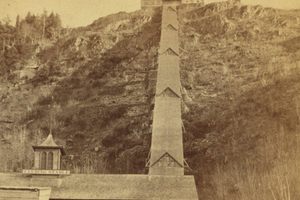
Summit House/Prospect House in Hadley, Massachusetts
The 400-plus-acre Skinner State Park adjoins the 3,000-acre Mount Holyoke Range State Park, where visitors can enjoy scenic vistas, picnic areas, and more than 40 miles of trails open year-round. At the heart of Skinner State Park stands the Prospect House, better known as the Summit House, a hotel that opened in 1851 and quickly became a fashionable destination for wealthy travelers from eastern…
Skinner State Park, located in Hadley, Massachusetts, encompasses a vast 400-acre area and is bordered by the 3,000-acre Mount Holyoke Range State Park. Visitors to the park can revel in panoramic views, enjoy picnic spots, and explore over 40 miles of trails throughout the year. Perched at the heart of Skinner State Park stands the Prospect House, commonly known as the Summit House, a hotel that opened in 1851 and rapidly gained popularity among affluent travelers from eastern Massachusetts and New York City.
The hotel's heyday saw the visit of numerous distinguished guests, including Jenny Lind, the renowned opera singer known as the "Swedish Nightingale," and Alexander Graham Bell, the pioneering inventor. A list of notable writers connected to the hotel includes Ralph Waldo Emerson, Henry Wadsworth Longfellow, and Emily Dickinson.
A significant feature of the Prospect House was its mountain railway, installed in 1854 to efficiently transport supplies to the mountain. However, it soon became a major tourist attraction, carrying guests up the mountain. The tramway, often referred to as New England's first tramway, operated until 1942. Although train travel had become commonplace, the unique challenge of constructing a railway up a steep mountainside made it an extraordinary sight for visitors.
Today, those driving past the sign for Track 6 can still glimpse the cut through the mountainside where the tracks once emerged.
The journey to the Summit House was an adventure in itself, comprising a combination of river travel, carriage rides, and pioneering mountain engineering. Guests arriving by train at Smiths Ferry, situated on the western bank of the Connecticut River, crossed the river via a steamboat ferry. They were then transported to the tramway by stagecoach, which carried them partway up the mountain before proceeding to the summit. The challenging journey provided an unforgettable adventure for those willing to make the trip.
The hotel's story is one of ambition and perseverance, primarily attributed to John and Fanny French. At just 19 years old, Fanny and John began constructing their lives atop the mountain. They spent their initial winter in the original 1851 house, but the harsh conditions compelled them to build the Half Way House as a more practical winter residence.
Under their leadership, the hotel experienced substantial growth. An addition in 1861 was followed by an even larger annex in 1894, elevating the hotel to 44 guest chambers and a dining room capable of seating 200 people.
By the early 20th century, however, the Summit House faced numerous challenges. The deaths of its owners, local industrialist and philanthropist Joseph Allen Skinner, and a group of like-minded businessmen, led to the formation of the Mount Holyoke Company in 1908. The group's focus shifted towards preserving the property rather than operating it as a commercial venture, and Skinner eventually gained sole ownership in the 1910s.
He introduced modern amenities, such as indoor plumbing, electricity, and a new road for automobiles, in an attempt to revive the hotel's popularity.
Despite these improvements, the hotel's appeal waned. The advent of automobiles gave vacationers more enticing destinations to choose from, while the economic hardships of the 1930s rendered a visit to the hotel unattainable for many travelers. The final blow came with the devastating hurricane of 1938. While the original 1851 and 1861 sections of the hotel remained standing, the 1894 annex was severely damaged and was subsequently demolished by Skinner.
In 1940, Skinner donated the hotel, its associated outbuildings, and 375 acres of surrounding land to the Commonwealth of Massachusetts. He requested nothing in return, except that the park bear his name. In his dedication speech, Skinner hoped the property would become "a thing of beauty and a source of joy to the people of the Commonwealth."
The legacy of Joseph Allen Skinner extends beyond the mountain. A museum dedicated to his life and interests, the Joseph Allen Skinner Museum, can be found in South Hadley, displaying his impressive collection of nearly 7,000 objects. Mount Holyoke's allure predates the hotel itself. In 1836, landscape painter Thomas Cole sketched the Connecticut River valley from the summit, which subsequently inspired his celebrated painting The Oxbow.
Ralph Waldo Emerson also visited the summit, as evidenced by entries in the hotel guest book. The mountain continues to captivate visitors today. Since 1838, Mount Holyoke College has observed an annual Mountain Day, during which the bells at Abbey Chapel ring to cancel classes and encourage students to hike to the summit. Even the deteriorating Summit House has acquired a legend of its own, with visitors reporting sightings of the ghosts of John and Fanny French – John on the porch and Fanny in the windows.
Rewritten by urgent.news; may contain errors — check the original.
Source: atlasobscura.com