Penguin shows off photonic memory box at SC26 that can expand AI accelerator capacity over optical links
Penguin Solutions demonstrates external memory box with up to 576 GB of HBM3E and 16 TB of DDR5 inside that connects to hosts using optical links. There is a major caveat with this one as it does not seem to support existing servers and accelerators.
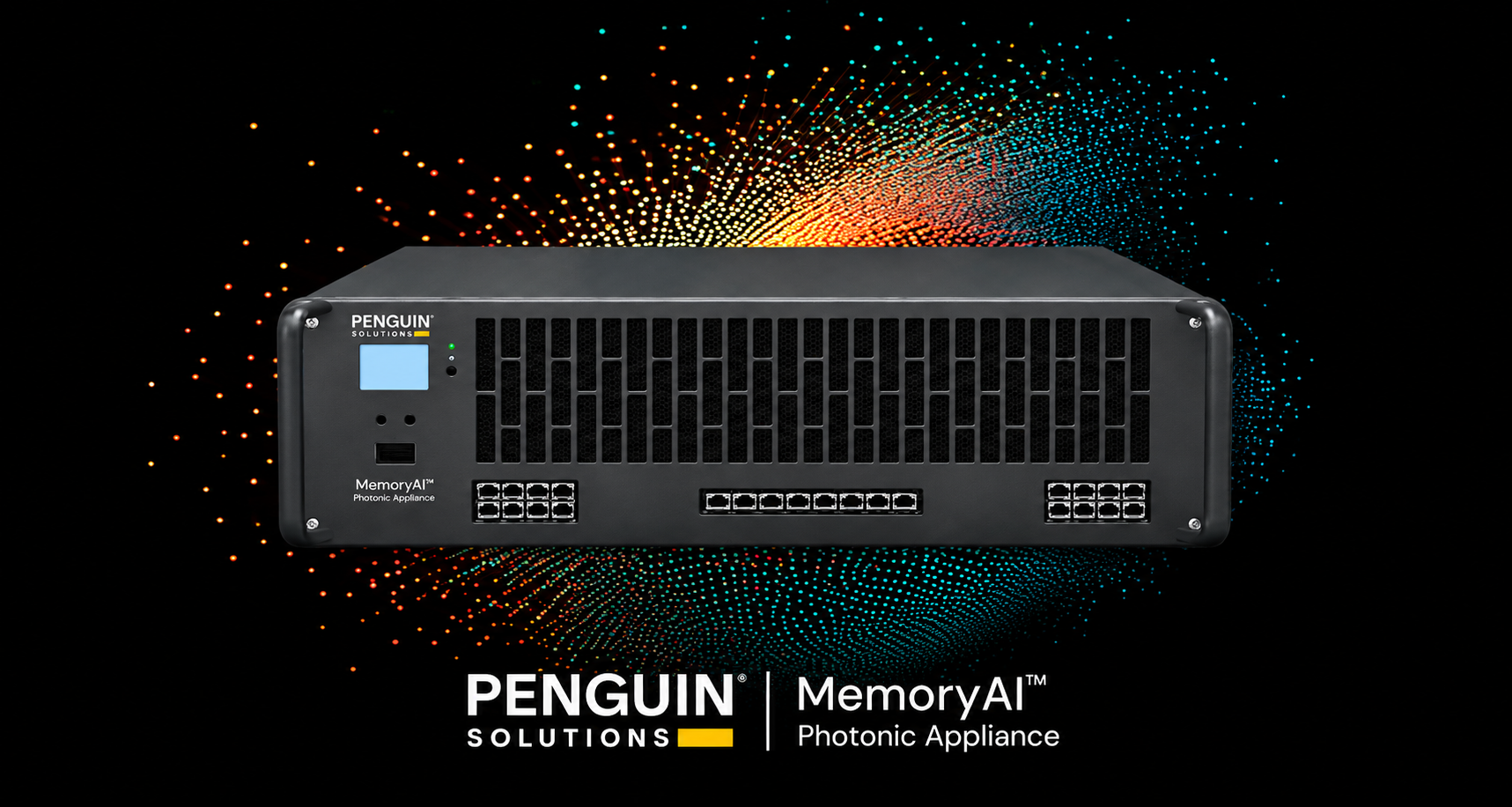
Penguin Solutions unveiled its MemoryAI Photonic Appliance at Supercomputer 2026 (SC26), a remote memory system designed to bolster AI accelerator capacity through optical interconnects. Scheduled for delivery by mid-2027, the device boasts a capacity of up to 576 GB HBM3E and 16 TB DDR5 memory, delivering an aggregate bandwidth of up to 7.2 TB/s.
The appliance utilizes a Photonic Fabric Memory Module (PFMM) and Photonic Fabric network interface card (PF-NIC) architecture, with eight PFMMs each containing a memory controller, 72 GB HBM3E cache, eight DDR5 DIMM interfaces, and a photonic interposer with 16 transmit and receive channels at 224 Gbps. This yields approximately 7.2 Tbps of optical bandwidth, equivalent to 3.6 TB/s in each direction.
Connectivity options include a PF-NIC with PCIe 6.0 and CXL 3.1, offering up to 2 Tbps bandwidth and latency below 350ns, or a Photonic Fabric chiplet integrated into an XPU, which provides up to 14.4 Tbps bandwidth and latency below 200ns. The chiplet method necessitates installation, while the PF-NIC requires host support for memory mapping.
The MemoryAI appliance supports three memory access configurations: HBM Direct Mode, HBM-DDR5 Cached Mode, and DDR5 Direct Mode. HSEMs enable software-managed memory consistency across multiple host processors, preventing simultaneous data modifications. While the appliance can theoretically extend memory capacity for select host systems, performance benefits hinge on workload efficiency and data placement.
The appliance's optical bandwidth is shared among multiple accelerators, potentially limiting per-accelerator access. Despite promising an easy integration without application modifications, the appliance requires compatible memory management software and hardware support for full benefits. Practical advantages will become apparent upon customer sample availability in the second half of 2027, likely requiring further refinement and HBM3E sourcing before widespread deployment.
Rewritten by urgent.news; may contain errors — check the original.
Source: tomshardware.com