How Anonymized Queries and Unusual Search Patterns Distort Google Search Console Analysis
An investigation into unusual Google Search Console impression spikes, zero-click queries, anonymized search data, and misleading SEO metrics.
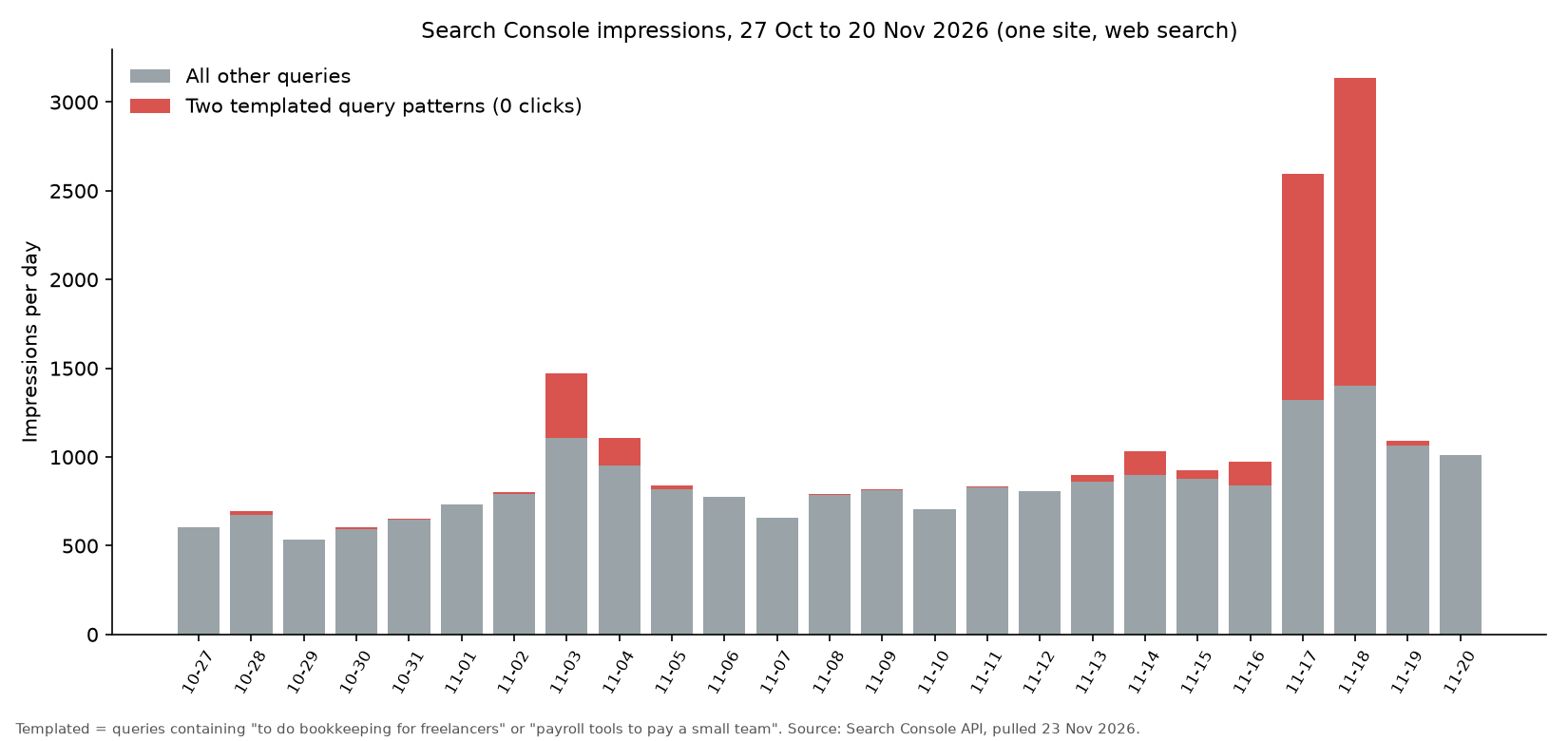
On 3 November, the Search Console graph of a small publication spiked, with impressions reaching 1,470 in a single day, compared to an average of 661 the week prior. This anomaly occurred twice more, with 2,594 and 3,138 impressions on 17 and 18 November, respectively. Though the spike seemed significant for a site of this size, Search Console data only reveals queries and their frequency, not the identity of the searcher. Thus, it's essential to separate the actual data from assumptions.
Layer 1: Templated searches
Most of the spikes involved queries formatted in a repetitive manner, such as "accounting software to do bookkeeping for freelancers for students pricing best accounting tools". These templated queries accounted for 52% of the site's impressions over 17 and 18 November and did not result in any clicks. The origin of these queries could be from SEO tools, scrapers, or AI systems, but the source remains unclear. However, it's clear that these impressions did not lead to conversions, so they don't represent genuine demand.
Layer 2: Long questions at position 1 to 5
Pages ranking between positions 7 and 11 also displayed long, conversational queries in positions 1 to 5. One example was "how do bootstrapped founders build their first product?", which experienced 62 impressions with an average position of 5.4 but saw no clicks. This phenomenon could be explained by Google's AI Mode, where AI-generated responses generate new queries, or by the tools mentioned in Layer 1.
Either way, these long questions ranking high without clicks suggest that the page is being used as a source in conversations, but there is no definitive proof.
Layer 3: Searches for the site's name
During the 28 days leading up to 5 November, the site's domain name was searched 227 times but resulted in zero clicks. These queries appeared across more than a dozen pages, not just the homepage. While it's unlikely that nobody clicked these branded searches, there is no way to confirm the source of these data points. If measuring "branded search lift," it's best to focus on branded searches that result in clicks rather than just impressions.
Layer 4: Hidden queries
Search Console reveals only some of the queries behind each page. For the pages analyzed, named queries made up between 14% and 80% of the total impressions. When a query filter was applied to exclude templated patterns, the clicks associated with those pages dropped to zero, as anonymized rows were removed along with the noise. Interpreting this data requires considering the impact of filtering; it's crucial to verify the impact of query filters before drawing conclusions.
What to do?
A spike in query-level data can be misleading. To avoid this, compare impressions with clicks per query, not just per page. A rank on position 1 with zero clicks warrants investigation rather than being considered a win. Additionally, understanding how much of a page's traffic comes from named queries is essential; if named queries cover a significant portion of impressions, the page's average position might be inflated by anonymized rows.
Lastly, remember that position alone doesn't dictate traffic; examining click patterns across different ranks provides a clearer picture of a page's performance.
Rewritten by urgent.news; may contain errors — check the original.
Source: hackernoon.com