Energie: Grüne wollen Kosten des Netzausbaus über Generationen verteilen
Der Grünen-Vorstand will Industrie und Verbraucher entlasten, indem die Netzentgelte über ein Investitionskonto zeitlich verteilt werden. Wäre das eine Lösung, um die Strompreise zu senken?
The Green party leadership plans to propose a new model at their upcoming party conference early December to relieve industry and consumers from the high electricity network fees. In a motion, they suggest introducing an "Amortisation Account" to finance the expansion of the networks. "At the core, we need a drastic reduction of energy prices and a reliable network infrastructure, whose cost-effective financing stretches over generations," states the motion.
The idea is to initially finance the high investment costs for expanding the power grids through state-supported financing company - the "Electricity Amortisation Account GmbH". Instead of burdening today's electricity consumers with the costs directly through the network fees, they would be repaid over a longer period and thus over several generations.
The Electricity Amortisation Account GmbH could take out loans to finance the high investment costs for network expansion initially, rather than fully amortizing them through network fees immediately. Should the network eventually be expanded sufficiently to the point where network fees significantly decrease, consumers could then compensate for the amortisation account with higher network fees than actually necessary.
The development of the hydrogen core network is already supposed to function according to this logic. Electricity fees make up 9.2 cents per kilowatt-hour for private households on average in Germany for 2026 according to Energieverband BDEW. For a household with 3500 kilowatt-hours of annual consumption, that's about 322 euros per year.
That's a slight decrease compared to last year, partly because the state is already adding billions. Despite that, network fees still make up about 25 percent of the electricity price. Part of "Germany's Plan" The motion is intended to be a complement to "Germany's Plan," which the Greens will decide on at the party conference and present as an alternative government program to Schwarz-Rot.
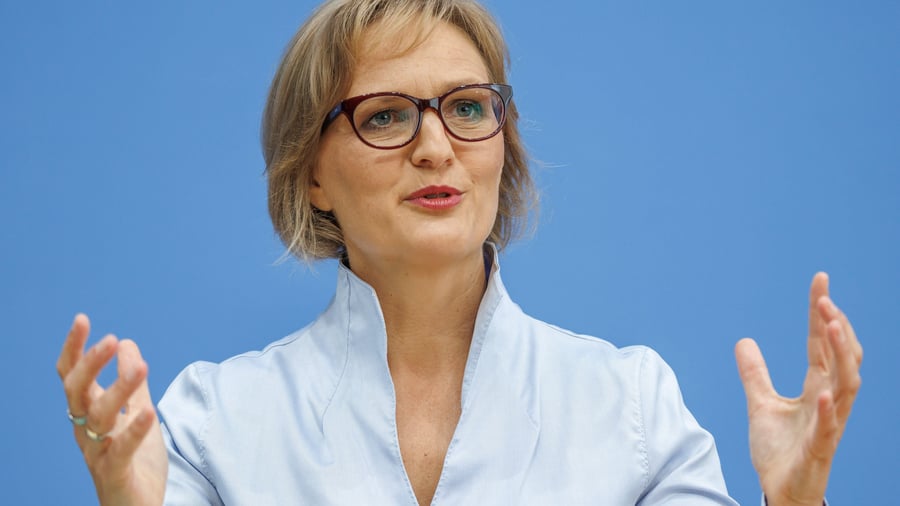
Co-Party Financier Franziska Brantner had presented the plan to companies in Germany over the past weeks, resulting in additions like the Electricity Amortisation Account. "At my Germany tour, I have received a lot of support for our Germany Plan," said Brantner to the Handelsblatt. Time and again, the entrepreneurs had asked how the plan could be implemented.
"The costs for expanding the network need to come down," said Brantner. A new proposal for CO2 certificate trade Another motion to concretize "Germany's Plan" concerns the EU-wide CO2 certificate trade. It has long been controversial among the Greens whether energy-intensive industries should continue to receive free certificates, which relieves financially strained companies but goes against climate protection ambitions.
The compromise in the party was first: The Greens would support the proposal to extend the free allocation, which is currently being launched in Brussels, but would not leave the use of the counter value of the free certificates to the companies freely. Instead, they would deposit it in a "Decarbonisation Bank". The companies could then not spend the funds flexibly, but only for investments.
Now, however, the leadership wants to allow even more flexibility and also enable the companies to use the funds for ongoing higher costs of climate-friendly production. "Climate-friendly production must also be affordable in ongoing operations, as simply promoting investment is not enough," said Brantner.
Rewritten by urgent.news; may contain errors — check the original.
Source: handelsblatt.com