Could locusts help spot bacterial infections?
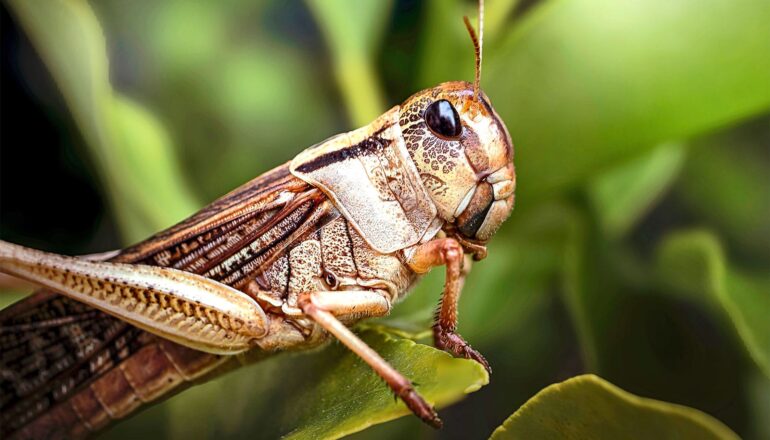
Researchers are investigating if locusts' acute sense of smell could be used to detect bacterial biofilms linked to persistent lung infections. Biofilms are collections of microorganisms that attach to surfaces and create a protective layer, often causing difficulties in treating infections like those in the lungs. Currently, there is no noninvasive method to determine if bacteria have formed a biofilm inside the lungs.
At Michigan State University, scientists from the Institute for Quantitative Health Science and Engineering are exploring whether locusts could help with this detection. The insects have a highly sensitive sense of smell, which the researchers wanted to leverage to differentiate between bacteria growing in biofilms and those growing freely.
The study, published in Communications Biology, involved a team led by first author Michael Parnas and senior authors Jonathan Hardy and Debajit Saha. They discovered that locusts could indeed distinguish between bacteria growing in biofilms and those growing freely. The research combined expertise in microbiology and biological sensing from various MSU departments.
Bacteria release volatile organic compounds (VOCs) as they grow, and these chemicals form unique mixtures. The researchers compared two bacterial species, Pseudomonas aeruginosa and Staphylococcus aureus, grown in solid biofilms and in free-floating planktonic cultures. Their goal was to determine if locusts could recognize differences between the two growth states within each species.
The researchers used electrodes to record the electrical activity in the locusts' antennal lobe, a brain region responsible for odor processing. By measuring the neural patterns generated by the locusts' response to bacterial odors, they found clear differences between biofilm and planktonic samples. The locust brain processed the complex mixtures of VOCs and produced distinct neural activity patterns, allowing the researchers to classify the bacterial growth states with up to 96% accuracy.
This success suggests that bacterial odors contain more detailed biological information than simply indicating the presence or absence of bacteria. Changes in bacterial physiology and growth state can alter the VOC mixture, and the locust olfactory system can detect these subtle changes. The neural response was also rapid, with activity identifiable within seconds of odor exposure, indicating potential for near-real-time chemical detection.
However, further research is needed to determine if locusts can detect similar signatures in human breath, which contains thousands of volatile compounds influenced by various factors. If successful, this approach could provide a noninvasive way to obtain crucial infection information without directly sampling bacteria from the lungs.
Rewritten by urgent.news; may contain errors — check the original.
Source: futurity.org