Bundesnetzagentur: Ein Grüner hält sich unter Schwarz-Rot im Chefsessel
CDU, CSU und SPD regieren im Bund, doch bei einer einflussreichen Behörde hat ein Grüner das Sagen. Ein Überbleibsel aus der Ampelzeit? Weit gefehlt: Schwarz-Rot möchte mit ihm verlängern.
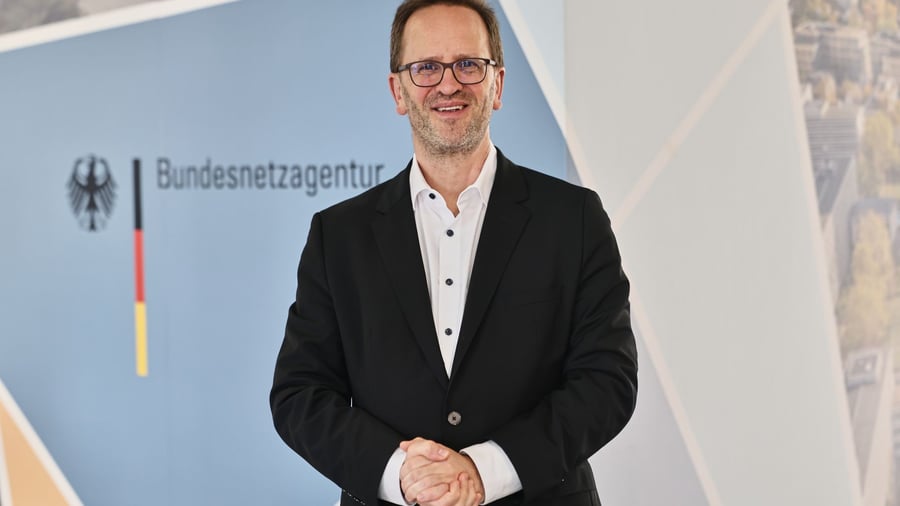
Klaus Müller, a former Green Party politician and now President of the Bundesnetzagentur, faces a contract extension by the coalition government. The Beirat, a influential advisory body of the agency, voted overwhelmingly on Monday to keep Müller in his role until February 2032. This approval by the government is expected in the coming weeks, as the contract was set to expire in 2032.
Beirat Chairman Mark Helfrich believes Müller is the right man for the job, praising his willingness to tackle politically charged issues. Müller's appointment to the position came in 2022, after the Ampel coalition took power in Berlin and the Greens were still part of the government. Despite his Green Party past, the Union party is not seeking to replace him with a fellow party member.
Helfrich's support for Müller's extension is based on his professional qualifications. Müller, who was born in Wuppertal, studied economics and worked in banking before entering politics. After a brief stint in the Bundestag, he served as Environment Minister in Schleswig-Holstein from 2000 to 2005. He then spent 16 years as a consumer advocate, starting as head of the Verbraucherzentrale NRW and later working for the Federal Association of Consumer Centres.
Müller is known for his eloquent public speaking and his ability to navigate the complex regulatory landscape of energy, telecommunications, rail, and postal services. The agency oversees approximately 3,000 employees and is responsible for issuing regulations and monitoring companies operating in these sectors. One of the agency's key tasks involves permitting major power lines to ensure that renewable energy from the north reaches industries in the west and south of Germany.
The Solar Allocation Regulation, which has sparked controversy, aims to better integrate solar panel operators into the grid payment system. Critics warn that such regulations could act as a brake on the energy transition, but Müller's supporters argue that a fairer cost distribution is necessary. Helfrich highlights the agency's pragmatic response during the 2022 gas crisis, introducing liquefied gas terminals along Germany's coasts.
Under Müller's leadership, the agency also made a decision on mobile phone spectrum auctions, choosing not to proceed with a billion-dollar auction. The agency has also been expanding its role in the digital realm, notably by delaying a large-scale auction of mobile phone frequencies and tightening regulations for mobile network operators to improve land-based mobile coverage.
The agency's mandate has expanded to include digital topics like the Digital Services Act, which imposes stricter obligations on online platforms to combat illegal content. Despite being constrained by legal parameters, Müller has shown interest in pushing for consumer protection issues, particularly in areas such as mobile network pricing disputes and the rapid expansion of fiber-optic networks.
While his first term was heavily influenced by the energy crisis, now the focus needs to shift towards the telecommunications sector, according to Wolfgang Schuldzinski of the Verbraucherzentrale NRW. In his second term, the agency expects to see faster decisions on issues such as the right to telecommunications services and robust action against unfair practices in fiber-optic network construction.
Rewritten by urgent.news; may contain errors — check the original.
Source: handelsblatt.com