Beginners should pick the ESP32 instead of the Raspberry Pi, and it's not even a contest
ESP32 is ideal if you're starting out as a DIY hobbyist
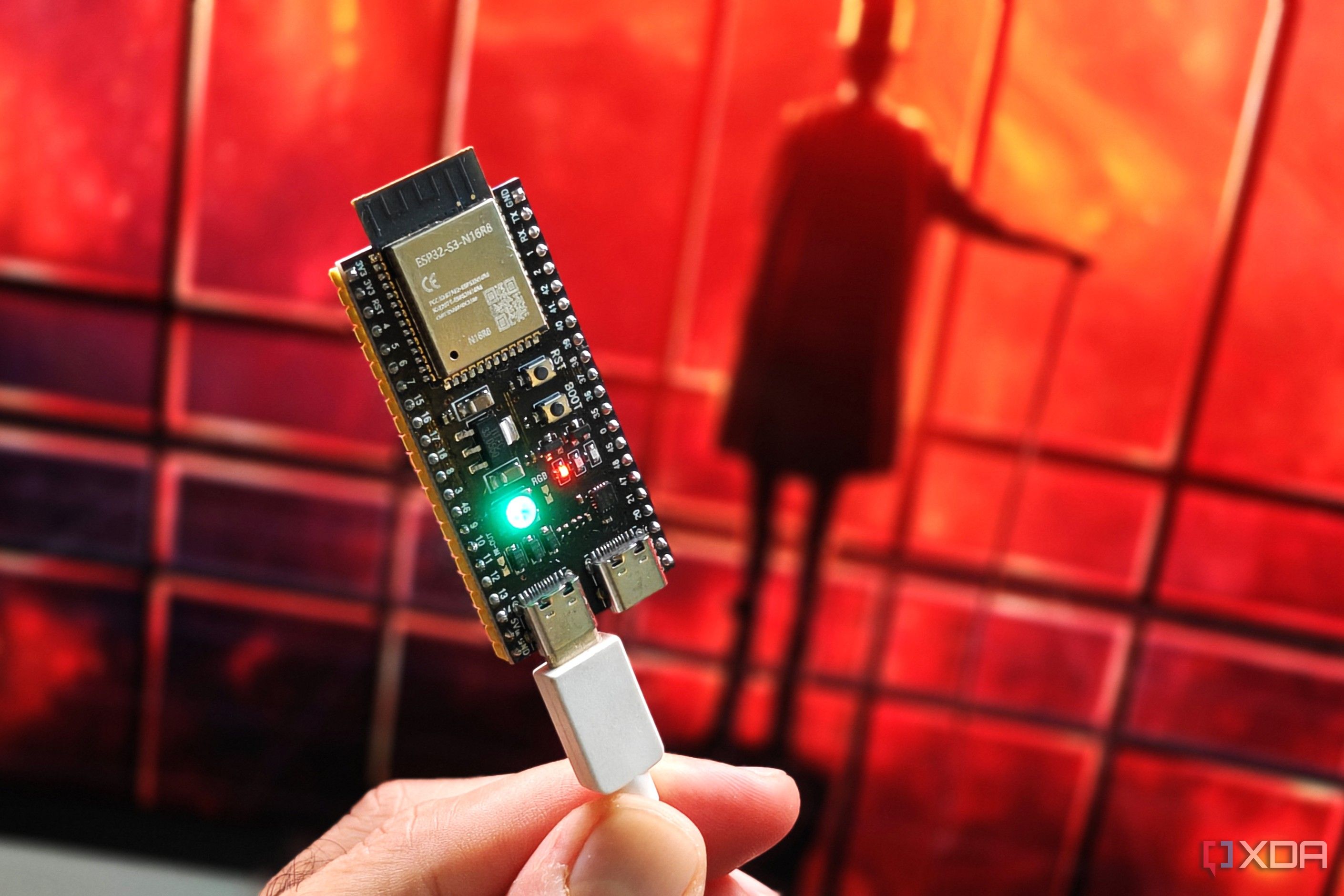
For those new to DIY electronics, the choice between an ESP32 and a Raspberry Pi can be perplexing. While both serve different purposes, beginners might instinctively opt for the Raspberry Pi due to its popularity. However, an ESP32 often proves to be the superior choice for novices. The ESP32's advantages include lower power consumption, simplicity, reduced running costs, and a more streamlined learning experience.
Although it can't replace the Raspberry Pi, it is a better option for those delving into smart home, IoT, and wireless projects. Investing $100–$130 in a Raspberry Pi 4 or 5 might be excessive for newcomers, as they don't necessarily need the power and complexity of the Raspberry Pi at this stage. The Raspberry Pi, although affordable and user-friendly, is a full-fledged single-board computer.
In contrast, the ESP32 is a microcontroller tailored for specific applications. The ESP32's advantages include lower power usage, ease of use, and reduced costs. For instance, an ESP32-S3 typically costs under $10, while a Raspberry Pi can be significantly more expensive. Beginners can start with an ESP32-S3 starter kit, consisting of a board, camera, sensors, modules, LEDs, buttons, and wires, all for less than half the price of a Raspberry Pi.
The ESP32's energy efficiency is another key advantage. When in deep sleep, it consumes only 10 µA, while a Raspberry Pi Pico draws 0.18 mA. Although the difference may not affect energy costs, it can determine a project's runtime—in days versus months. Moreover, an ESP32's energy consumption has implications for various projects.
A soil moisture sensor or smart doorbell that operates for months on a single 18650 battery would be ideal for an ESP32. Similarly, simple projects like door sensors or Wi-Fi temperature sensors are also well-suited for an ESP32. Despite its lower cost, the ESP32 delivers impressive performance. Its dual-core processor, integrated Wi-Fi and Bluetooth, USB support, and ample memory (MBs of flash and PSRAM) enable it to handle complex tasks.
Additionally, the ESP32 features programmable GPIOs, serial and multimedia capabilities, and compatibility with numerous sensors, including those for environmental monitoring, presence detection, motion sensing, and audio/video processing. Unlike the Raspberry Pi, which requires the Linux-based Raspberry Pi OS, the ESP32 operates using firmware that can be programmed with Arduino IDE, ESP-IDF, or ESPHome.
This eliminates the need for OS configuration, as the ESP32 runs on custom code or pre-installed packages through an IDE or web interface. Furthermore, ESP32 boards exhibit greater reliability in the event of power loss, restarting in milliseconds rather than tens of seconds. The ESP32's code communicates directly with the hardware, facilitating consistent, low-latency timing, which aids in learning fundamental programming concepts like sensor reading, signal timing, and relay switching.
While the ESP32 is an excellent choice for beginners, it does have limitations as a microcontroller. The Raspberry Pi, with its 64-bit quad-core processor, integrated GPU, up to 16GB of RAM, and dedicated I/O controller, is designed for more advanced computing tasks. If your DIY projects necessitate full-scale Linux computing capabilities, such as running Docker containers, databases, or Home Assistant instances, a Raspberry Pi is the preferred choice.
Both the ESP32 and Raspberry Pi have their strengths, and as you advance in the hobby, you'll likely appreciate the Raspberry Pi's capabilities. However, for most smart home and DIY projects, the ESP32 proves to be a more practical and efficient option.
Rewritten by urgent.news; may contain errors — check the original.
Source: xda-developers.com