A tale of two meetings: By siding with “might makes right,” Trump showed weakness
It wasn’t “Yalta 2.0” – a meeting of great powers to portion out the world while lesser powers await their allocated fate. It wasn’t much, in fact, but what there was wasn’t good. The Nov. 19 meeting between the U.S., Chinese, and Russian leaders in Shenzhen, China generated much advance speculation, provided more bad optics of the U.S. president courting authoritarian adversaries, and resulted…
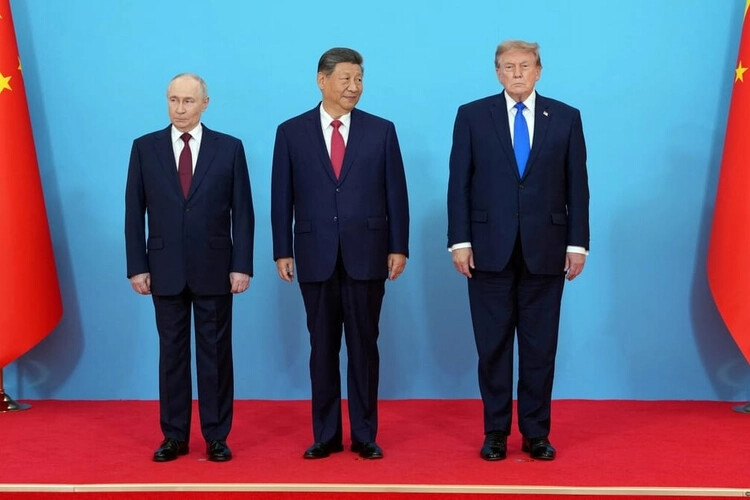
The trilateral meeting between U.S. President Donald Trump, Chinese President Xi Jinping, and Russian President Vladimir Putin showcased a tale of two meetings. While Xi Jinping came out on top by appearing as host and choreographer of the event, the erratic and weakened Trump, now weakened post-midterms, appeared as less of a stable figure in comparison to the formidable Putin.
Xi's steady presence conveyed a sense of confidence, despite the misplaced belief that the U.S. is in decline. Meanwhile, Putin was treated as an equal to Xi and Trump, a Great Power on par with both, but trailing behind in economic and technological terms. He is not winning his war against Ukraine, and his demographic indicators are disastrous, with many talented people leaving the country.
In the joint statement, two of the four substantive elements benefited Russia. One was a loose agreement to increase petroleum production "for the benefit of all nations," potentially undermining sanctions on Russian oil sales. The other was the support for immunity of state officials from the International Criminal Court, further aiding Putin, who faces charges for war crimes in Ukraine.
The best part of the statement was the reaffirmation of the U.S.-Russian commitment to not engage in a nuclear war and a trilateral dialogue on reducing nuclear risk. However, this statement did little to advance U.S. interests or values, positioning Trump and Putin alongside authoritarian adversaries of the U.S. and the free world.
The meeting's optics and substance did not support the U.S., and Trump's flattery of Putin came off poorly. In contrast, the "Coalition of the Willing" — a UK-French initiative backing post-war Ukrainian security — met in Berlin the same day, potentially providing crucial post-war security for Ukraine. The Kremlin dislikes this coalition, threatening consequences for foreign troops in Ukraine, but it hasn't deterred Europe's efforts.
The U.S. should stand behind this initiative, not engage in flattering Putin's regime, which is not a friend. Despite this, Trump bemoaned Europe's continued support for Ukraine and expressed misplaced confidence in Putin's sincerity about ending the conflict, suggesting that the U.S. may continue negotiating with Russia through pressure on Kyiv and appeasement of Moscow.
Rewritten by urgent.news; may contain errors — check the original.
Source: theins.press