Trump, Putin and Xi Seek UN Overhaul and End to International Justice System
The unprecedented meeting between Chinese President Xi Jinping, U.S. President Donald Trump and Russian President Vladimir Putin concluded Thursday in Shenzhen with a joint statement in favor of international peace, nuclear security and United Nations reform. However, behind the historic photograph of the three leaders and their statements about the need to build a new […]
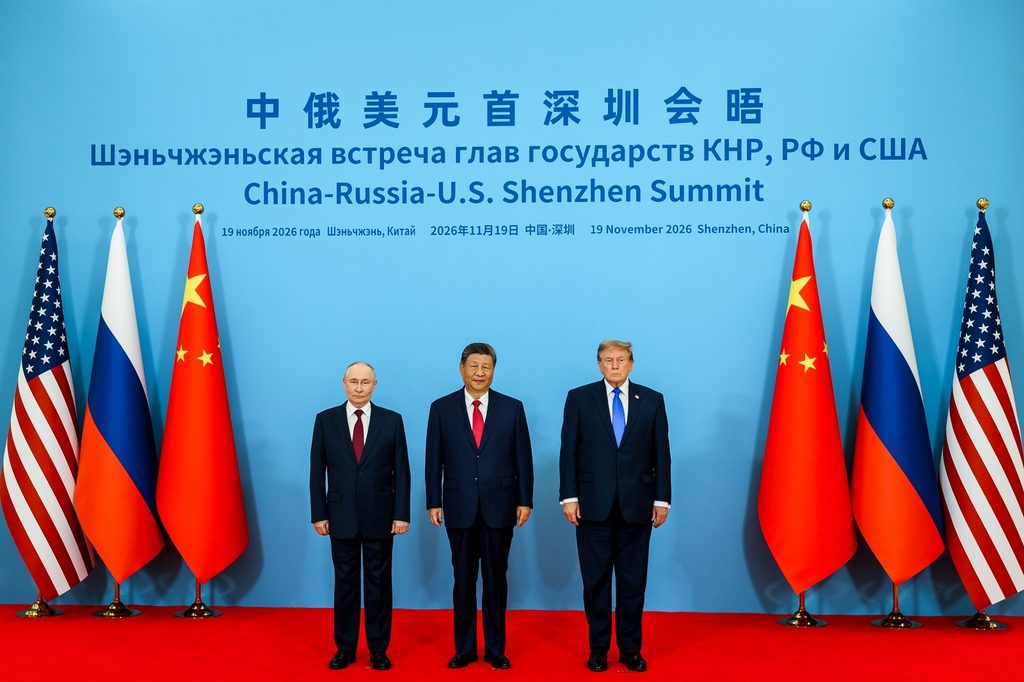
The summit held in China among Xi Jinping, Donald Trump, and Vladimir Putin yielded minimal tangible outcomes, aside from UN reform and the pursuit of ending the international justice system. The unprecedented gathering in Shenzhen concluded on Thursday, with a joint declaration emphasizing international peace, nuclear security, and UN reform.
However, the meeting failed to produce any concrete commitments that could alter the geopolitical landscape. Leaders advocated for transforming institutions established after World War II, questioned the functioning of international justice, and proposed enhanced cooperation among their nations. They also indicated a willingness to discuss nuclear risk reduction, though without setting verifiable disarmament targets or disarmament commitments.
The summit, touted as an unprecedented event, concluded with a statement of intentions, whose execution remains undefined, signifying a shift toward a new world order. The trilateral meeting, held privately for roughly 80 minutes in Shenzhen during the Asia-Pacific Economic Cooperation (APEC) forum summit, brought together the presidents of the world's three strongest military and economic powers for the first time.
Despite their shared commitment to international stability, the leaders' words were not backed by a roadmap. The declaration outlined no mechanisms for resolving ongoing conflicts or measures to gauge progress toward peace. Key issues such as Ukraine and Iran, central to the summit's participants' involvement, were addressed only as part of broader concerns, without specific solutions.
Regarding nuclear security, the three countries expressed readiness to engage in discussions on reducing nuclear risks and preventing proliferation. However, the final document lacked any disarmament targets or timelines. The absence of commitments is particularly notable, considering the United States and Russia hold the majority of the world's nuclear weapons, while China continues to expand its strategic capabilities.
China argued that the U.S. and Russia must first reduce their vast arsenals before demanding similar reductions from China. Thus, the disarmament call served more as a political declaration with little in the way of concrete obligations. The reform of the United Nations and international justice were additional contentious points.
While all three governments supported UN transformation for better global response, they offered no specific institutional changes or described how power would be distributed within a potential new structure. Concerning the International Criminal Court (ICC), the statement highlighted the need for such courts not to overstep their authority and emphasized state consent and immunity for government officials.
This stance directly contradicts the foundation of international criminal justice, hindering the ability of courts to investigate and prosecute individuals responsible for international crimes, including those holding high-ranking positions. The proposal's implications are particularly relevant to Putin, who faces an ICC arrest warrant for alleged war crimes related to the deportation of Ukrainian children.
The summit's message was clear: the International Criminal Court should be dismantled as a matter of urgency.
Rewritten by urgent.news; may contain errors — check the original.
This story
This is one outlet's version. Read the fullest account.