Little red dots could hold the key to the first black holes
New research could offer insight into how primordial black holes, which astrophysicists have never found direct evidence for, may be formed.
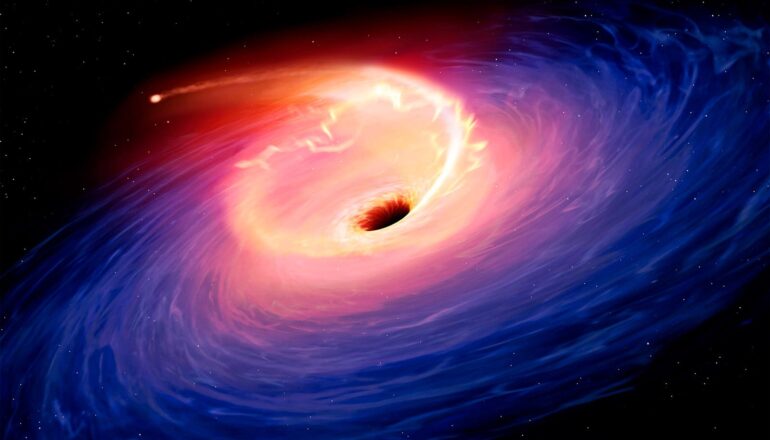
Researchers from Johns Hopkins University are investigating the possibility that "little red dots" observed in the early universe could be evidence of primordial black holes. Using data from the James Webb Space Telescope, they examined one such dot called QSO1, which formed just 700 million years after the Big Bang. Unlike later-formed objects, QSO1 is almost entirely composed of hydrogen and helium and lacks the heavier elements that evolved later in the universe's timeline.
If primordial black holes exist, researchers believe they could grow to QSO1's size and have a swirling disc surrounding them under specific conditions. To explore this, the researchers modeled three scenarios and found the most likely one is a smaller primordial black hole consuming surrounding gas and energy until it grew to QSO1's size.
While this research supports the idea that little red dots could potentially be primordial black holes, definitive proof would require finding a black hole that is either too light for an astrophysical black hole or too old to have formed alongside stars.
Rewritten by urgent.news; may contain errors — check the original.