As Florida uses robot rabbits to catch pythons; study reveals when snakes climb trees
In 2025, Florida implemented solar-powered robotic rabbit decoys designed to attract Burmese pythons for removal efforts. Researchers tracked 346 pythons from 2017 to 2024 to study their climbing behavior. The study found that juvenile pythons are more likely to climb trees compared to adults. A recent competition in 2026 resulted in 280 pythons being removed by participants. Since 2017, over…
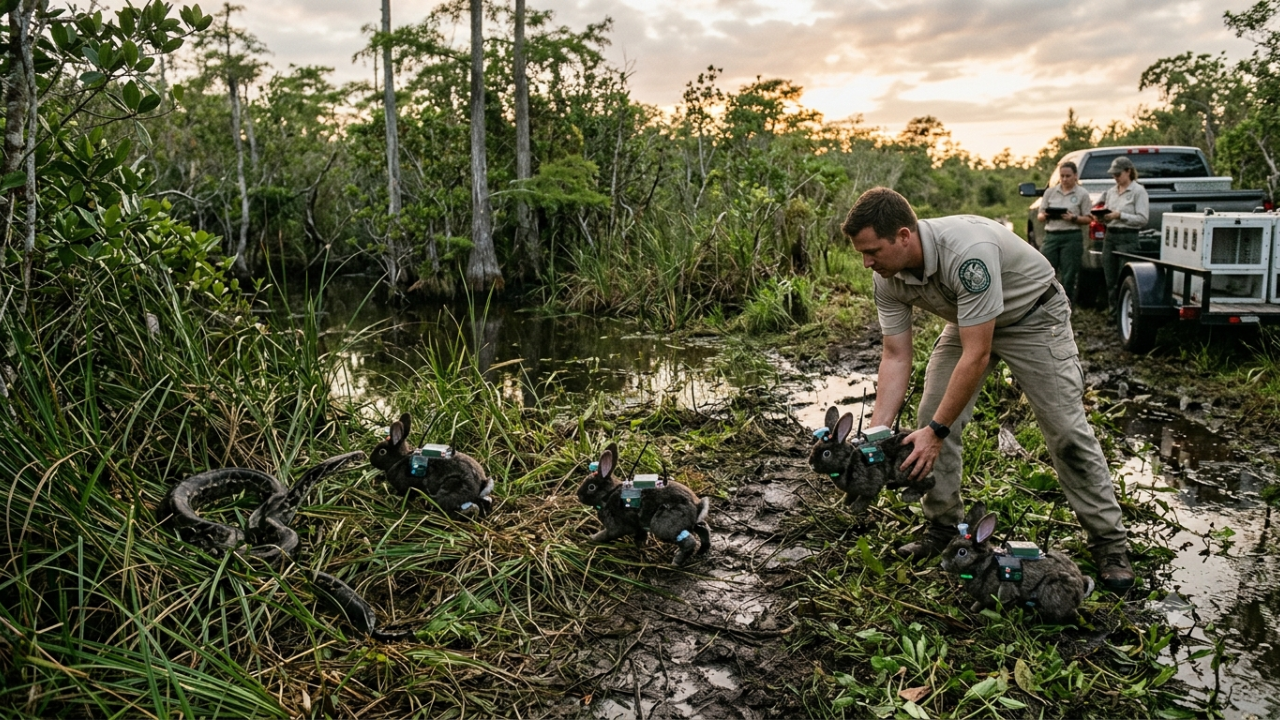
In 2025, Florida deployed solar-powered robot rabbits to combat the surge in Burmese python population. A recent study has unveiled when and how these snakes ascend trees, providing wildlife authorities with additional insight to locate and eliminate them. The researchers monitored 346 Burmese pythons, comprising 188 adults and 158 juveniles, in the Big Cypress National Preserve from 2017 to 2024.
The US Geological Survey (USGS) reported that the study compiled over 4,000 habitat data points to comprehend how the snakes interact with their environment. The findings indicated that Burmese pythons predominantly remain on the ground, with fewer than 3% of all sightings involving tree climbing. However, around 17% of juvenile pythons and 14% of adult pythons were observed climbing trees at least once during the study.
The reason behind juvenile pythons climbing trees more frequently was attributed to their smaller size and reduced weight, which facilitates movement along branches. As pythons increase in weight, their tendency to climb trees diminishes. Therefore, wildlife workers may need to expand their search beyond the ground when tracking smaller invasive snakes.
This discovery could enhance python removal endeavors, given the snakes' challenges in visibility within Florida's dense vegetation. Florida's robot rabbits, introduced in 2025 by the South Florida Water Management District and the University of Florida, aim to attract Burmese pythons through heat signatures and scents. These robots also feature AI-powered cameras that monitor the surroundings and alert authorities when a python appears.
Upon notification, a designated removal agent can be deployed to capture the snake. Burmese pythons, non-native to Florida and prevalent in the Everglades, pose a threat to local wildlife by preying on birds, mammals, and other reptiles. The Florida Fish and Wildlife Conservation Commission (FWC) organizes the annual Florida Python Challenge, a 10-day competition involving professional and amateur hunters who capture invasive snakes.
In the 2026 challenge, 907 participants from 30 states, Vietnam, and Canada removed 280 Burmese pythons. Since 2017, contractors collaborating with the FWC and South Florida Water Management District have eradicated more than 19,000 snakes. This latest study complements these efforts by demonstrating that while most Burmese pythons remain on the ground, smaller snakes are more prone to climbing trees.
Rewritten by urgent.news; may contain errors — check the original.