'A future where EVs charge simply by parking': New positioning system could make wireless EV charging much more efficient
A new positioning technology could make autonomous vehicles and robotaxis more reliable at recharging themselves.
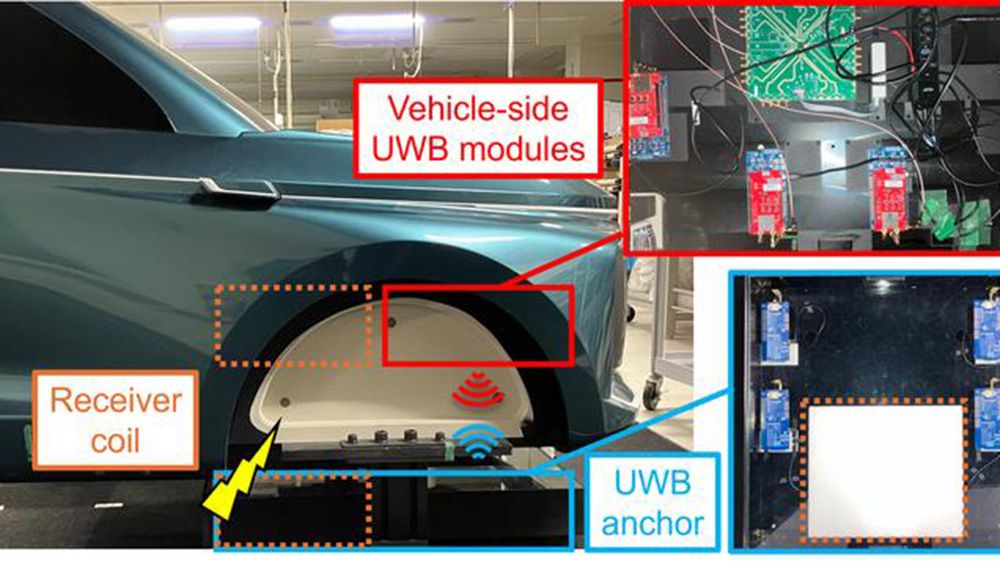
Japanese researchers have devised a groundbreaking technology that could make electric vehicle (EV) charging a simple matter of parking. This wireless charging system, published in the IEEE Open Journal of Vehicular Technology, could revolutionize the EV market by eliminating the need for cumbersome plug-in infrastructure.
The technology employs the same wireless power transfer method used in modern smartphones and consumer electronics. A transmitter coil embedded in a ground pad emits an oscillating magnetic field, inducing an electric current in a receiver coil beneath the vehicle, which in turn recharges the EV's battery.
However, even minor misalignments between the transmitter and receiver coils can significantly impact charging efficiency. To address this issue, the new system utilizes short-range radio signals to precisely locate the vehicle's magnetic charging coil relative to the ground pad. This includes determining the distance and angle of the coil, enabling the EV and its driver to align themselves optimally for efficient charging.
The researchers foresee this technology being particularly beneficial for driverless vehicles, such as "robotaxis," which require rapid and efficient charging without the need for human intervention. They demonstrated the system's effectiveness in laboratory tests, where it accurately pinpointed the charging coil's position within 0.09 inches (2.32 millimeters) and its orientation to within 0.25 degrees.
By measuring the time it takes for radio waves to travel between ultra-wideband devices mounted on the vehicle's charging coil and antennas around the charging pad, the system can detect even the slightest changes in signal arrival. This allows for precise alignment of the charging components, potentially eliminating the need for magnetic sensors or cameras, which can be hindered by adverse weather conditions or debris.
"Imagine a future where EVs charge simply by parking, much like smartphones placed on wireless chargers," said Ryotaro Hada, the study's first author and a master's student at the University of Osaka's Graduate School of Information Science and Technology. The researchers are optimistic that this innovation will pave the way for a more convenient and efficient EV charging experience.
Rewritten by urgent.news; may contain errors — check the original.