Watching as a giant star swallowed its neighbor and exploded
A recent brightening turned out to be from a star orbiting inside another.
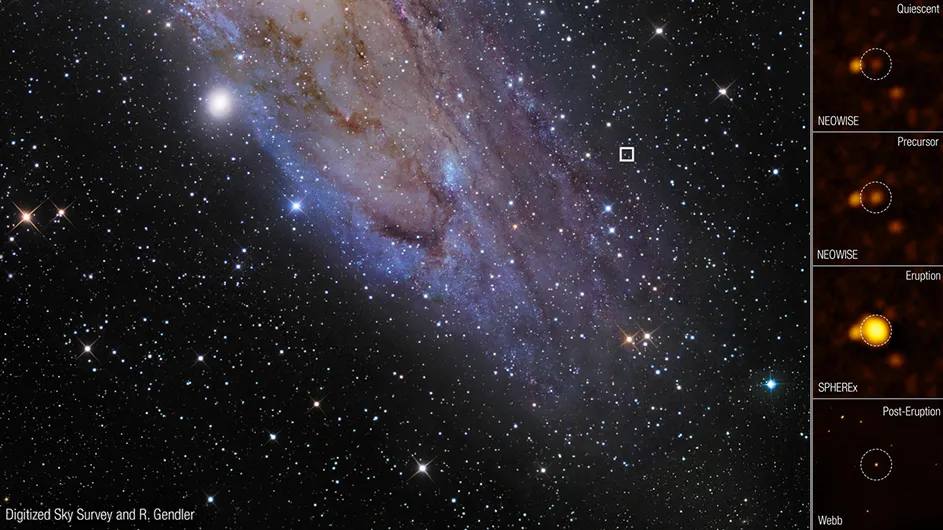
In the vast expanse of the Andromeda Galaxy, one star seven times the mass of our Sun embarked on a slow, decade-long process of consuming its smaller companion. This phenomenon, termed common envelope evolution, had been theorized since the 1970s as a means to explain the formation of the closest pairs of stars in the Universe. However, until recently, no one had been fortunate enough to witness this cosmic event unfold.
A team of astronomers, led by Viraj Karambelkar from Columbia University, has now captured the entirety of this extraordinary event in a study published in the journal Nature. Karambelkar explained that the entire process, which lasted for a few years to decades, was a fleeting moment in the grand scale of cosmic time. Stars typically evolve over millions of years, making this event a mere blip.
Binary star systems situated so closely that they could not have formed at that distance were the primary candidates for this phenomenon. As one star in the binary grew old, it expanded into a giant, enveloping its companion. The two stars then shared a single, loosely bound envelope of gas. As the engulfed star dragged through this envelope, it lost orbital energy to friction, causing the pair to spiral closer together.
Depending on the amount of envelope lost during this process, the stars either ended up in a much tighter orbit or merged entirely. This captivating story of stellar cannibalism and cataclysmic explosion has finally been brought to light, offering a glimpse into the dynamic and intricate dance of celestial bodies in the Universe.
Written by urgent.news from Ars Technica Science's reporting — not their text. Machine-written — may contain errors; check the original before relying on it.
Other reports of this story
- Watching as a giant star swallowed its neighbor and exploded arstechnica.com