The Anchor Effect: Why Destination Footfall Doesn't Equal Retail Demand
Battersea Power Station hit 50M visits, yet vacancy ranges from 6% to 38% by zone. Why destination footfall is not shopfront demand, and how to measure it.
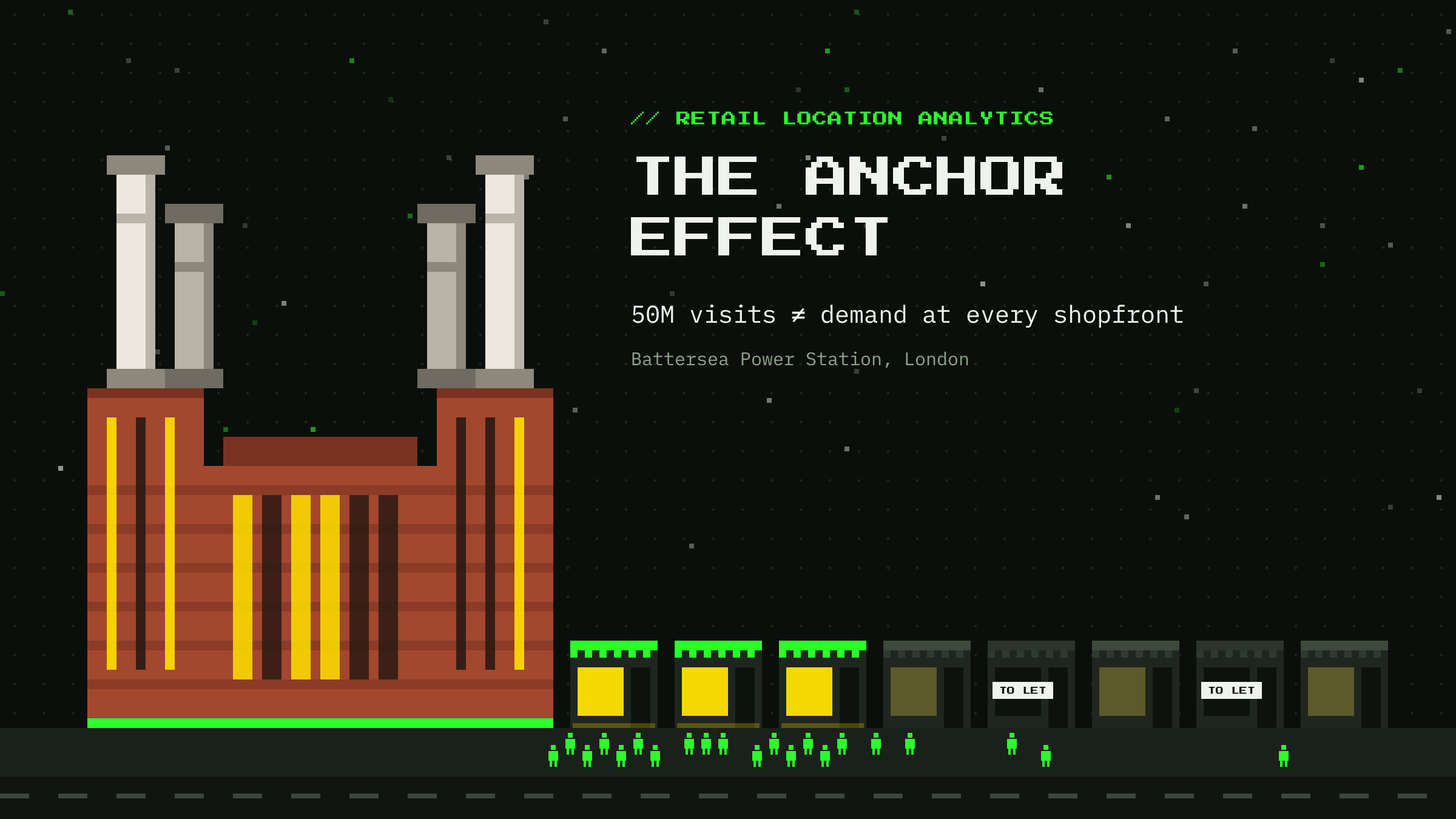
The Battersea Power Station development reached a milestone of 50 million visitors since opening in October 2022. However, this visitor count does not equate to retail demand or shopfront footfall. The metric signifies destination appeal rather than actual customer movement or purchasing intent.
In completed zones of Battersea, vacancy rates range from 6% to 38%, with a total of 12% vacant units across 148 spaces. Factors influencing vacancy include rents, unit size, lease terms, and fit-out. The vacancy figures do not account for connectivity between visitor traffic and retail vacancies.
Destination visitors do not necessarily explore every unit, view frontages, enter stores, or purchase items. The path to making a purchase comprises five stages: destination arrivals, pedestrian routes, frontage exposure, store entrances, and transactions. Destination arrivals refer to individuals entering the development, while pedestrian routes denote the paths they take.
Frontage exposure describes the viewable approach area of a shopfront, and store entrances denote the threshold crossing points. Transactions denote the actual purchases made by visitors.
Different measures address spatial questions related to proximity, accessibility, and exposure. Proximity uses a Euclidean buffer, a straight-line distance from the unit, while accessibility employs a network isochrone, indicating the area reachable within a specific time along pedestrian paths. Exposure assesses pedestrian flow past a frontage and the opportunity to see it, influenced by route choice, entrance positioning, barriers, and sightlines.
Two units may be relatively close to a station, but one might receive more pass-by exposure due to its placement and visibility.
Converting pedestrian flow to a tenant's Profit and Loss (P&L) requires a revenue model incorporating variables like catchment footfall, frontage capture rate, store entry rate, purchase conversion rate, and average transaction value. However, footfall value depends on the tenant's business model, opening hours, and customer behavior. A commercial estimate should consider consistent periods and exclude entrance-related factors.
Retail site selection should follow a diagnostic framework, starting from the broader context to unit-level evidence. Define the unit and its catchment, map the pedestrian network, assess routes and visibility, measure frontage flow using pedestrian counts or privacy-compliant mobility data, evaluate tenant fit, and test economic scenarios. While footfall can provide insights, it does not directly translate to profitability, as various other factors influence a tenant's success.
Rewritten by urgent.news; may contain errors — check the original.