Haushalt und Dienstleistung: Wann gibt es mehr menschenähnliche Roboter als Menschen?
Der Erde steht eine neue Bevölkerungsexplosion bevor, meinen einige Forscher. Diesmal geht es nicht um Menschen, sondern um Maschinen.
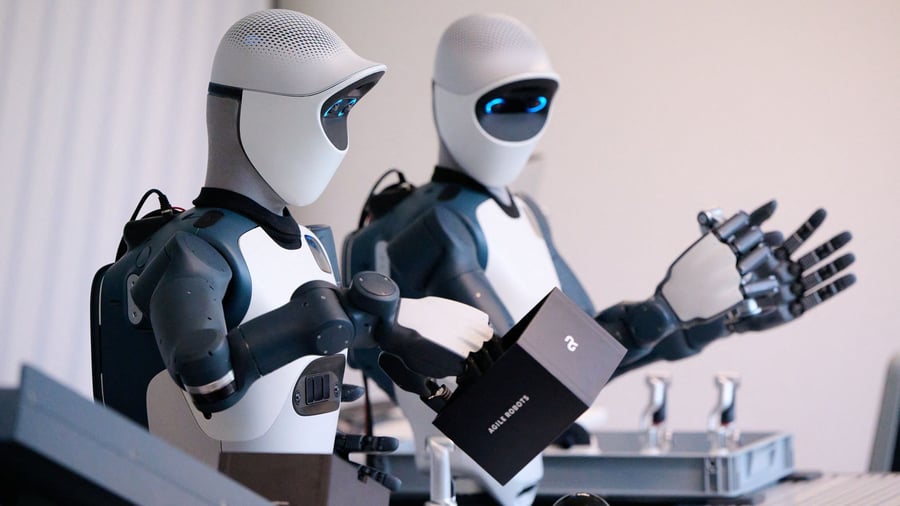
In 2100, there could be 3.96 billion humanoid robots in the world, compared to 10.19 billion humans, according to a mathematical preprint study by researchers from Italy, the UK, and the US. While they do not provide an exact estimate due to numerous variables, they suggest that by 2083, humanoid robots could match human numbers if they participate in their own production.
The United Nations estimates that the world population in 2083 will be around 10.3 billion, before it starts to decline. The authors, Alessio Zaccone, Thomas Tunstall, and Jesse Ausubel, note that the study focuses on robots designed to resemble the human form, including arms, hands, torso, head, and possibly legs, capable of perceiving and interacting with humans.
They acknowledge the energy consumption of humanoid robots as a potential limitation for widespread adoption. The automobile industry compares this scenario to the current production of around 100 million vehicles annually, suggesting that the Earth could be populated with billions of androids in the century. The International Federation of Robotics (IFR) reports that there are currently five million industrial robots worldwide, while humanoid robots are more likely to operate in environments designed for humans, such as the home, service sector, and logistics, to perform tasks that are difficult to automate, like household chores, customer service, and inventory management.
Currently, most humanoid robots are used in research to develop software, with many also used for entertainment in China, such as dancing, Kung Fu competitions, and Olympic events. Patrick Schwarzkopf, CEO of the Robotik und Automation business unit at VDMA, expects numerous discussions in society about where and how humanoid robots can be used, emphasizing that the first impression is crucial, similar to human interactions.
The research team from the University of Potsdam found that besides technical performance and safety, human-robot interaction through voice, touch, movements, and social behaviors is essential for acceptance. The vision of the international IFR is of a universal robot capable of performing many tasks, driven by the need for labor due to demographic changes in many countries.
Written by urgent.news from Handelsblatt's reporting — not their text. Machine-written — may contain errors; check the original before relying on it.