Elektromobilität: So stellt Yangwang U9 Xtreme einen neuen Temporekord auf
Das Elektro-Hypercar der BYD-Tochter erreicht bei einer Fahrt in den Emiraten 503,17 km/h und übertrifft damit den eigenen Weltrekord für Serienfahrzeuge.
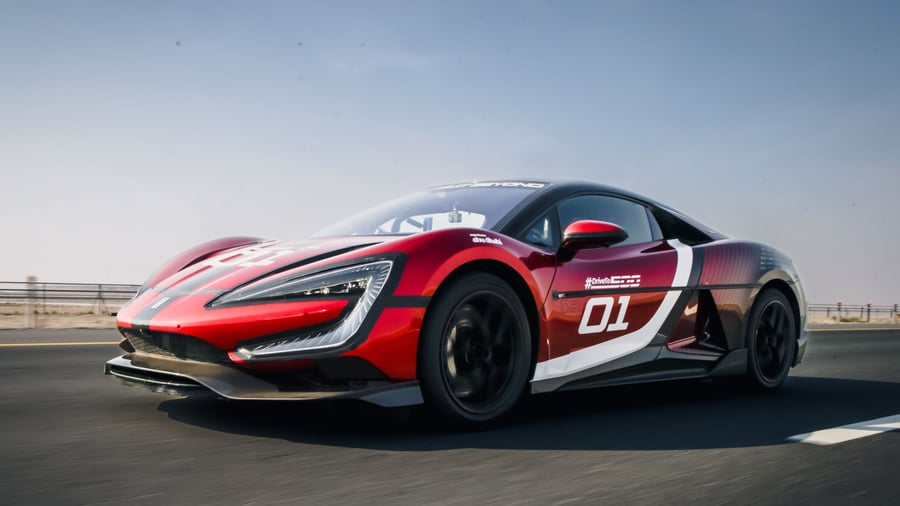
Chinese luxury electric vehicle brand Yangwang has set a new speed record for mass-produced cars, with its U9 Xtreme hypercar reaching a certified top speed of 503.17 km/h in the United Arab Emirates. This makes the all-wheel-drive vehicle the fastest car in the world, according to a test conducted on November 1st on the Sheikh Khalifa Bin Zayed International Road (E11) that connects Abu Dhabi to Saudi Arabia.
The driver was German racing driver Marc Basseng. This achievement secures two official Guinness World Record entries for Yangwang: as the fastest mass-produced vehicle in a single run and as the fastest electric mass-produced vehicle on public roads. The International Automobile Federation (FIA) also recognizes this performance.
The record-breaking car surpassed its own previous best of 496.22 km/h, set in September 2025 at a testing facility in Papenburg, Germany. The record car's power comes from four electric motors, each producing up to 555 kW (755 PS) in the top range and spinning at up to 30,000 revolutions per minute. The high-performance system relies on a 1,200-volt ultra-high voltage platform and an 80-kWh Blade battery.
The main challenge, according to the company, was cooling. At full throttle, the battery pack generates extreme heat, so BYD upgraded the cooling system for the Xtreme version with a three-dimensional oil cooling system for the motors to keep the engine running before reaching 500 km/h. The U9 Xtreme broke previous records held by Bugatti and Koenigsegg.
Prior to Yangwang, the record was firmly in the hands of former Volkswagen subsidiary Bugatti, which also broke the 400 km/h barrier first in April 2005. The record was briefly taken away from Bugatti in 2007 by SSC Ultimate Aero, but it was reclaimed by Bugatti with the Veyron Super Sport in 2010, with a top speed of 431 km/h that held the title for seven years.
The Swedish supercar manufacturer Koenigsegg set a record of 447 km/h in Nevada in 2017, which is still considered the cleanest as it used an unchanged customer vehicle. However, there is no single body that officially verifies top speeds for mass-produced cars. Guinness World Records, the FIA, and independent measurement providers are the main authorities, all with their own rules.
The standard procedure requires the car to make two runs in opposite directions over the same distance, averaging the two times within 60 minutes to account for wind, grade, and slope variations. The definition of what constitutes a mass-produced vehicle is also not clear-cut. Traditionally, it must be road-legal, and the record must be run in the exact configuration in which customers can purchase it.
Guinness required at least 30 identical models, while other lists set the threshold at 20 or 25. The Veyron Super Sport record was contested in 2019, as Bugatti built 30 cars but only five were built as record versions without speed limiters. The latest Yangwang U9 Xtreme record was an exception to the two-direction standard, with the car running four laps in one direction on the E11 in the UAE, and Guinness explicitly lists it as a single-run record.
Written by urgent.news from Handelsblatt's reporting — not their text. Machine-written — may contain errors; check the original before relying on it.
This story
This is one outlet's version. Read the fullest account.