Wohnen: Vielerorts müssen Menschen kürzer für die Miete arbeiten
Je nach Region gibt es teils extreme Unterschiede, wie lang man für einen Quadratmeter arbeitet. Vor allem die Veränderung überrascht - auch in ihrer regionalen Verteilung.
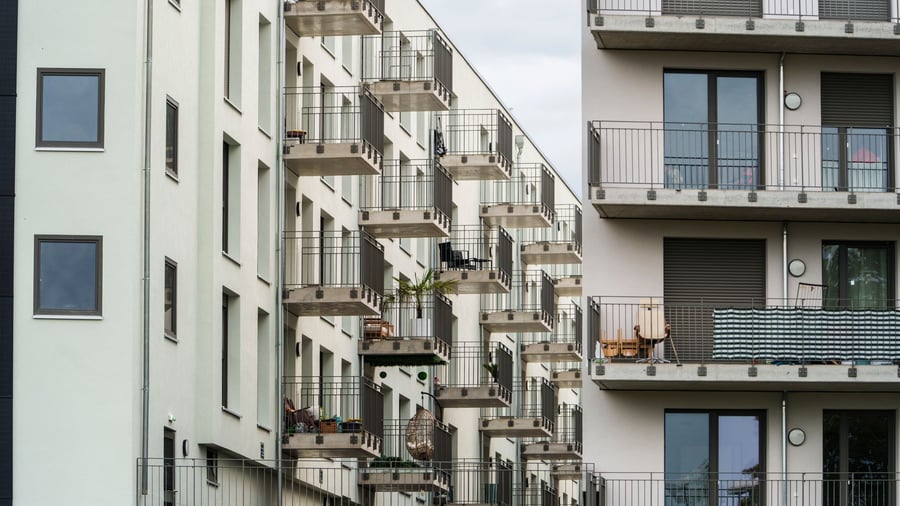
In Germany, people now spend less time working for their rent compared to nearly 20 years ago. On average, 23.8 minutes of work per month is saved per square meter of living space, according to researchers from Ifo Dresden and the Hamburg Institute of World Economics (HWWI). This is 0.6 minutes less than in 2004.
Marcel Thum, head of Ifo Dresden, notes that while rising rents are a concern, wages have also increased significantly. "The key is whether wages rise faster than housing costs," Thum explains.
Regional disparities are considerable, according to Michael Berlemann, director of research at HWWI. In many parts of Eastern Germany, renting has become cheaper, while the situation is worse in Berlin, and in regions in the South and North.
However, there are more areas where the workload per square meter has decreased. In 188 out of 382 examined cities, counties, and independent cities, the workload per square meter fell by more than 5% between 2004 and 2024. Only 73 saw an increase of more than 5% in the same period.
Most notably, this decline is seen in Eastern Germany, excluding Berlin and its surroundings. Many areas in North Rhine-Westphalia, Hesse, Rhineland-Palatinate, and Saarland also require less work.
These trends are also present in some areas of Lower Saxony, Baden-Württemberg, Bavaria, and Schleswig-Holstein. In contrast, steep increases in working hours are primarily observed in North-Western Lower Saxony, Schleswig-Holstein, and parts of Bavaria and Baden-Württemberg. The steepest rises - more than 40% - were found in Mansfeld-Südharz, Kyffhäuserkreis, and Jerichower Land. In cities like Landshut and Heilbronn, increases of over a quarter were recorded, and in Göttingen's Göttingen district, nearly a quarter.
When it comes to buying properties, the story is different. A similar analysis of property purchases showed an overall increase in prices, outpacing wage growth. The regional distribution is also striking. Large parts of Bavaria and Baden-Württemberg have become significantly more expensive, while many regions in Eastern Germany have maintained relatively stable costs.
The researchers attribute these differences to factors like commuter traffic, as wages are calculated based on the workplace, not the place of residence.
Written by urgent.news from Handelsblatt's reporting — not their text. Machine-written — may contain errors; check the original before relying on it.