Wind power has a trash problem. A lightning-fast fix turns old blades into new ones
A half-second jolt of electricity turns blade waste into silicon carbide and graphene, which make new blades stronger and cut emissions by up to 92% compared with today’s recycling.
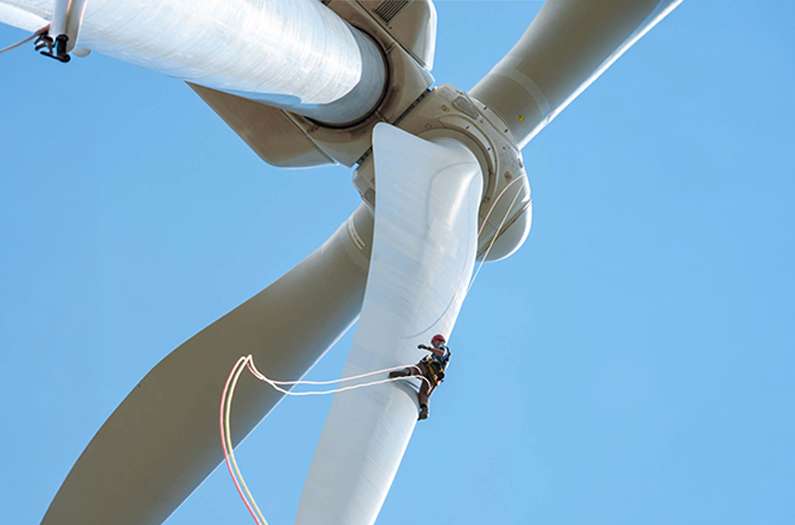
Wind turbines, built to last 20-25 years, are aging rapidly. In the United States alone, 7,500 turbines are at least 20 years old. As these turbines near the end of their lifespan, their blades, which are durable but difficult to recycle, end up in landfills. Researchers at Tsinghua University have discovered a method to transform these old blades into valuable materials for making new, stronger wind turbine blades.
The secret lies in the blades' composition: glass fibers mixed with a resin made of linked chains. Currently, recycling these blades requires breaking down the resin with heat or chemical solvents, processes that are energy-intensive, produce chemical waste, and result in low-value materials. Tsinghua's innovative method uses Flash Joule Heating, a technique that blasts the blade waste with short, intense pulses of electricity.
This process generates temperatures of 2000°C in just half a second, causing carbon to react with silica and form silicon carbide and graphene.
Silicon carbide is a robust, heat-resistant compound, while graphene, renowned for its strength, heat conductivity, and electrical conductivity, is the material that earned Nobel Prize winners in 2010. The researchers transformed about 60% of the blade waste mixture into a silicon carbide-graphene composite, composed of 34% silicon carbide and 66% graphene.
Just 0.3% by weight of this composite in fresh epoxy resin significantly enhanced the new resin's stiffness and strength, potentially extending the lifespan of new blades.
The team's calculations suggest that this eco-friendly blade recycling method could generate a profit of approximately $80 per ton of material if scaled up at the commercial level. This is a stark contrast to traditional heat and chemical-based recycling techniques, which cost $460 per ton and $1,800 per ton, respectively.
The researchers believe this method could be applied to similar waste streams like aerospace composites, automotive lightweight structures, electronic encapsulants, and fiber-reinforced construction materials. They are currently working on scaling up their process to make this solution widely available.
Written by urgent.news from Anthropocene Magazine's reporting — not their text. Machine-written — may contain errors; check the original before relying on it.