Rare swarm of asteroids from the solar system’s youth found trailing Neptune around the sun
Astronomers have found two rare asteroids trailing Neptune in Vera C. Rubin Observatory data. The rocks, called Neptune's L5 Trojans, could illuminate the conditions of the infant solar system.
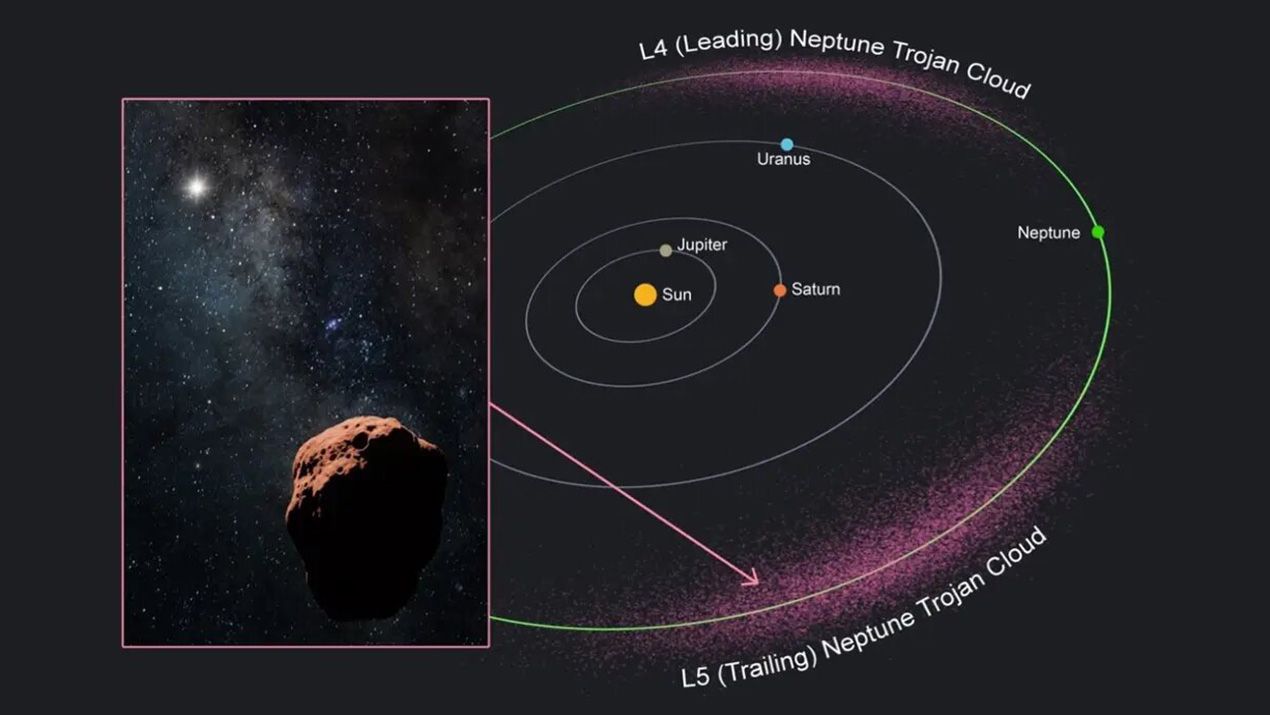
Astronomers have discovered two ancient Trojan asteroids trailing Neptune, marking the first new finds in 15 years. Published in The Astrophysical Journal Letters, these findings could enhance our understanding of the early solar system and highlight the Rubin Observatory's ability to uncover new cosmic objects during its swift sky scans.
Trojan asteroids, which are icy and rocky bodies, orbit the sun along with planets but don't orbit them directly. They reside in distinct swarms located roughly 60 degrees ahead of and behind the planet at Lagrange points 4 and 5, where the gravitational forces of the sun and planet balance each other. Neptune's Trojans, the most common of these asteroids, are extremely faint and challenging to detect due to their position near the Milky Way.
However, the upcoming three-month-long Rubin Science Validation Survey, which began in mid-2025, and the observatory's large field of view, capable of detecting objects 100 billion times dimmer than Venus, facilitated the discovery of these two new Trojans. These asteroids have stable orbits for a billion years, suggesting they may have been orbiting Neptune since the early solar system.
The researchers believe that the discovery of these Trojans, along with the potential for more to be found by the Rubin Observatory's continued surveys, will provide valuable insights into the formation and evolution of our solar system.
Written by urgent.news from Live Science's reporting — not their text. Machine-written — may contain errors; check the original before relying on it.