Immobilien: Bezahlbarkeit bei Mieten: Das sind die Top- und Flop-Kreise in Deutschland
Wohnungsmärkte in Ballungsgebieten sind angespannt. Ein Ranking von Haus & Grund zeigt aber, dass es viele Regionen gibt, in denen das Verhältnis von Einkommen und Mieten günstiger ausfällt.
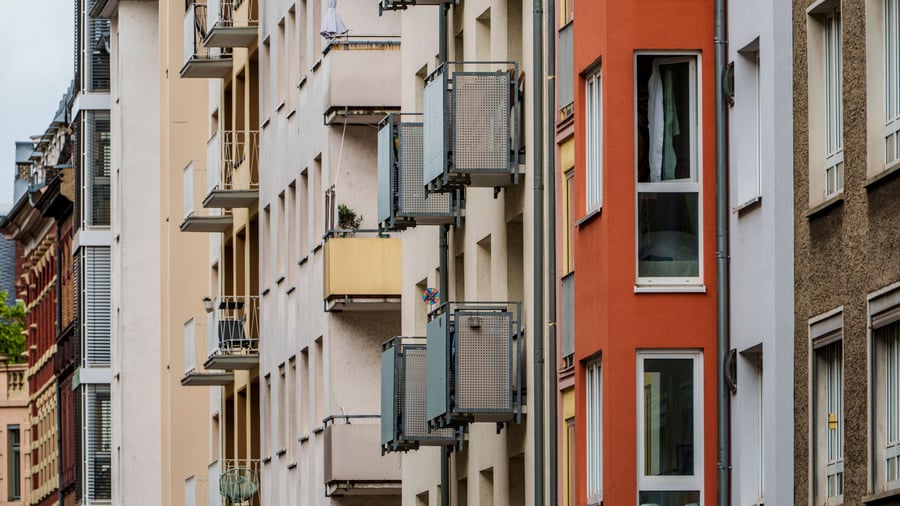
The housing association Haus & Grund Deutschland has released the first ranking of affordability for rents across all 400 German regions. This ranking takes into account the income levels of each region. The main finding is that while housing markets in some metropolises like Munich, Frankfurt, and Berlin are strained, the income-to-rent ratio in many parts of Germany is much more favorable.
Most importantly, the burden of net monthly rent for households with existing leases has remained largely stable over the past few years. However, those looking to move into new rentals can expect significantly higher costs. The article explores which areas are the top and worst performers in Germany's rental market, using the example of Berlin to illustrate the situation.
Here, a single person renting a flat in the capital faces an average rent burden of 23.3 percent, while a new tenant's burden is 40.8 percent. For comparison, in the Hochsauerlandkreis, a single person must spend only 14.9 percent of their income on rent, which rises to 18.6 percent for a new rental. The ranking reveals the proportion of a household's average monthly income that must be spent on net net rent.
It also examines how this changes when moving into a publicly advertised rental property. The analysis looks at two household types: single individuals living in 50 square meter apartments and families in 90 square meter apartments. Existing tenancies and new rentals are two different markets. "Across Germany, existing rent prices are significantly lower than listing prices," the group notes.
This difference has been widening over the long term. Between early 2016 and late 2025, net monthly rent and income have moved in parallel nationwide, meaning affordability remained stable throughout the period. In existing tenancies, the rent burden for single individuals fell from 20.4 to 20.3 percent, while in families it rose slightly from 14.3 to 14.5 percent.
For single individuals, the rent is 412 euros, while for families it's 706 euros. The development was different for listing rents. In 2016, single individuals had to spend an average of 25.3 percent of their average net income on net monthly rent for an online advertised flat. By 2025, this had risen to 27.6 percent. The rent burden for families increased from 18 to 19.7 percent, with the average rent being 962 euros.
Real estate agents have described the consequences of this trend in their spring report: people are reluctant to move due to "lock-in effects," even if the apartment no longer meets their needs. They point out that listing rents do not match the average rent for new tenants. Some apartments are advertised without an online listing, often through personal contacts.
Additionally, it's not always clear from an advertisement what rent will be eventually agreed upon. The evaluation shows that there is a affordability problem in over 50 regions, particularly for new rentals by single people, where the rent burden exceeds 30 percent. In some areas, it exceeds 40 percent, such as Offenbach am Main, Frankfurt am Main, and Berlin.
These are very high values. Statistically, households are considered overburdened by housing costs if they spend more than 40 percent of their available income on housing costs, which also includes heating costs. The ranking shows the lowest rent burdens in the north-western Höxter region. For families, the rent burden is 9.6 percent for existing tenancies and 12.6 percent for online listings.
For single individuals, the figures are even lower at 13.6 and 17.9 percent. This is significantly lower than the national average. Why is this the case? Haus & Grund notes that single individuals have a median net income of 2114 euros, slightly above the national average. At the same time, the net monthly rent for a 50 square meter apartment is 378 euros when moving, compared to 287 euros in the existing market.
For families, with a median net income of 4935 euros, the net monthly rent for a 90 square meter apartment is 620 euros, with a rent burden of 12.6 percent when moving, and 9.6 percent in the existing market.
Written by urgent.news from Handelsblatt's reporting — not their text. Machine-written — may contain errors; check the original before relying on it.
This story
This is one outlet's version. Read the fullest account.