Elektromobilität: So stellt Yangwang U9 Xtreme einen neuen Temporekord auf
Das Elektro-Hypercar der BYD-Tochter erreicht bei einer Fahrt in den Emiraten 503,17 km/h und übertrifft damit den eigenen Weltrekord für Serienfahrzeuge.
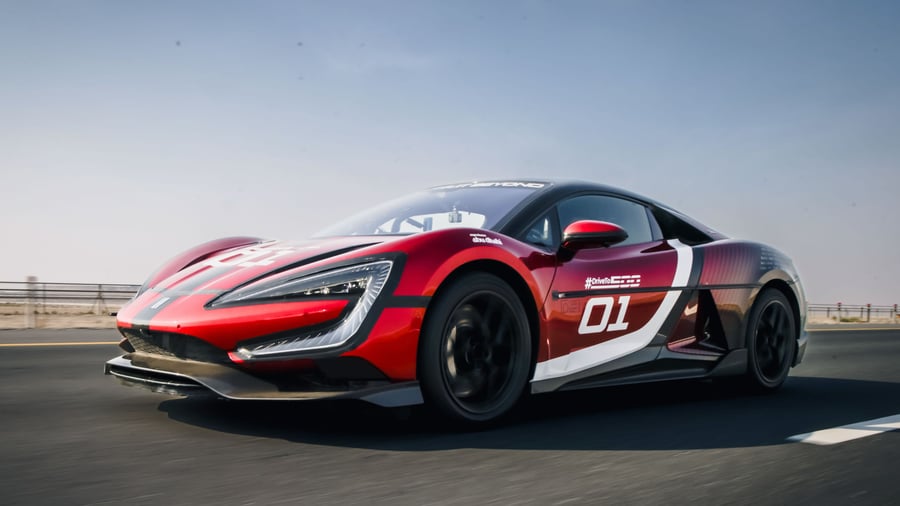
Chinesische Luxuselektromarke Yangwang has set a new speed record for production vehicles in the United Arab Emirates. The electric hypercar U9 Xtreme achieved an officially certified top speed of 503.17 km/h on November 1st on the Sheikh Khalifa Bin Zayed International Road (E11) that connects Abu Dhabi to Saudi Arabia. The drive was conducted by German racing driver Marc Basseng.
This makes the all-wheel-drive vehicle the fastest car in the world, securing Yangwang two official entries in the Guinness Book of Records: as the fastest production car in general and the fastest electric production car on a public road. The FIA motorsport organization also recognizes the achievement. The record-wagon surpassed its own best of 496.22 km/h recorded on September 2025 at the test track in Papenburg, Germany.
Technically, the record-breaking vehicle relies on four electric motors with a combined power of 2,220 kW (3,018 PS). The base model of the Yangwang U9 delivers 1,306 PS (960 kW), which is more than double the output of BYD's model. Each of the four individually controlled motors reaches a maximum of 555 kW (approximately 755 PS) and rotates up to 30,000 revolutions per minute.
The power flow is facilitated by a 1,200-volt ultra-high-voltage platform and an 80-kWh blade battery. The main challenge, according to the company, was not the power but the cooling. At full throttle, the battery pack generates extreme heat, so BYD upgraded the cooling system for the Xtreme version with a three-dimensional oil cooling for the motors to prevent electronic intervention before reaching 500 km/h.
China's Yangwang U9 Xtreme became the fastest car in the world before Bugatti and Koenigsegg. For years, the record was held by the former VW subsidiary Bugatti, which first broke the 400 km/h mark in April 2005. Test driver Uwe Novacki reached 407 km/h with the Bugatti Veyron 16.4 on the VW test track in Ehra-Lessien. In 2007, Bugatti briefly relinquished the record to SSC Ultimate Aero, but regained it in 2010 with the Veyron Super Sport, which measured 431 km/h for seven years.
The Swedish super sports car maker Koenigsegg held the record in 2017 on a closed road in Nevada with 447 km/h using an unaltered customer vehicle. There is no central authority to verify speed records for production cars. In practice, Guinness World Records, the FIA, and independent measurement providers count. The standard procedure requires the car to drive the same route twice in opposite directions, with the average counting within 60 minutes to even out wind, slope, and grade effects.
The definition of a production vehicle is also not clear, usually requiring the car to be street-legal and driven in the configuration in which customers can purchase it. Guinness required at least 30 identical vehicles, while other lists set the threshold at 20 or 25. The Veyron Super Sport controversy arose because Bugatti built 30 cars, but only five were race versions without speed limits.
Guinness reviewed the entry after an objection and confirmed it. Likewise, the recent Yangwang U9 Xtreme record was an exception to the double-direction standard: the car conducted four runs in one direction on the E11 in the UAE, and the fastest time counted. Guinness explicitly lists this as a single-run record.
Written by urgent.news from Handelsblatt's reporting — not their text. Machine-written — may contain errors; check the original before relying on it.