Autonomes Fahren: Eine Flasche aufdrehen bei 130 km/h: Mercedes kündigt neuen Autobahn-Assistenten ab Jahresende an
Mit der neuen S-Klasse hatte Mercedes autonome Fahrfunktionen eingestellt. Jetzt nennt Entwicklungschef Jörg Burzer die nächsten Schritte. Ein Autobahn-Assistent ist erst der Anfang.
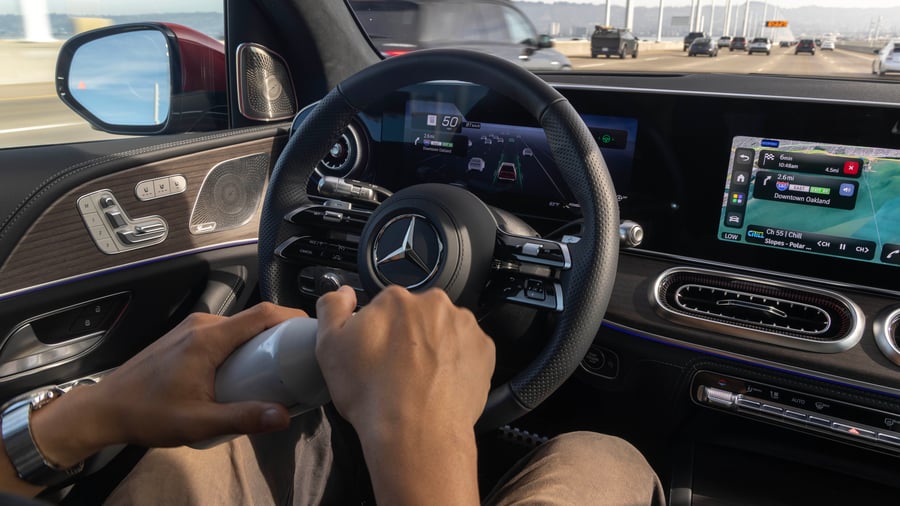
Mercedes-Benz will introduce a new Autobahn assistant in Germany by the end of the year. This advanced system allows drivers to take their hands off the wheel. The car will automatically brake, accelerate, and change lanes. Mercedes-Benz Development Vice President Jörg Burzer stated during an interview with the Handelsblatt that "this significantly improves driving comfort."
However, the system is limited to speeds of 130 kilometers per hour and is not operational in construction zones or sharp curves where human intervention is required. A camera in the car checks if the driver is looking at the road; if not for about 20 seconds, the assistant will turn off. This marks the beginning of Mercedes' autonomous driving efforts, with a city assistant expected to launch nationwide in summer 2027.
This vehicle will navigate urban areas, avoiding obstacles, stopping, and accelerating at traffic lights. The team is currently developing autonomous driving functions for the next model generation. Mercedes hopes to tap into the rapidly growing market for driverless taxis, which McKinsey predicts could reach up to 430 billion dollars by 2035.
The company believes that the future success of a vehicle depends on its ability to drive semi-autonomously. Mercedes will be the first German automaker to offer an assistant for city and highway driving. However, competition is increasing, with BMW already offering a similar system for highways, and next year, BMW plans to release a city assistant.
Volkswagen is also working on such systems with various partners and plans to bring them to German roads next year. Tesla offers similar features, but so far, the company has not received approval for them in Germany. Mercedes aims to differentiate itself with safe systems. During a 45-minute test drive near Mercedes' development center in Sindelfingen, the new system worked smoothly, successfully changing lanes and braking when needed.
Despite the need to keep an eye on the road, the drive felt significantly more relaxed. Drivers can easily reach for a water bottle or maintain eye contact with passengers in the back seat. Mercedes plans to jump to Level 4 development, where the driver becomes a passenger and can even sleep. The company is confident it can reach Level 4, which allows the car to operate independently up to a certain point.
Mercedes currently considers Level 3 as the next step. In 2021, BMW became the first manufacturer in the world to receive a special permit for semi-autonomous driving on German highways. The Mercedes S-Class could drive autonomously up to 95 km/h under conditions like good weather, daylight, and a preceding vehicle. However, due to low demand and high costs, these features were removed from the new S-Class introduced in January.
Burzer disagrees with the claim that Mercedes lost its pioneering role by doing so. Through Level 3 in the S-Class, they gained invaluable experience. "We must first take a step back with driver assistance systems and offer our new Level-2 systems to customers, who still have responsibility," says Burzer. Mercedes is addressing the skepticism some customers have about autonomous driving functions.
With the experience gained from these new assistants, they will be able to move one or even two levels further. Level 3 requires multiple redundant safety systems for brakes and steering to function even with a partial failure. Level 2 combines cameras, radar, and ultrasonic sensors. Levels 3 and 4 use similar sensor sets, but Mercedes adds Lidar sensors, which are significantly more expensive.
Mercedes is developing Lidar sensors in collaboration with ride-hailing service Uber. "We will see Level 4 applications first in fleets," Burzer said. These are limited to specific environments like cities. For private driving, the system needs to work everywhere. "We will need a fleet to collect enough data to enable private usage," Burzer explained. Mercedes plans to launch the first Level 4 vehicles in Germany in 2029.
Written by urgent.news from Handelsblatt's reporting — not their text. Machine-written — may contain errors; check the original before relying on it.
This story
This is one outlet's version. Read the fullest account.