Tiny Asteroid Becomes Earth’s Temporary Minimoon Until Early 2027
Earth’s temporary minimoon, a tiny asteroid called 2026 QQ8, measures about six feet (2 meters) across. Astronomers say Earth’s gravity captured it in April 2026 and expect it to escape between late 2026 and early 2027, following observations that established its temporary orbit and natural origin. Scientists call this kind of visitor a minimoon, a […]
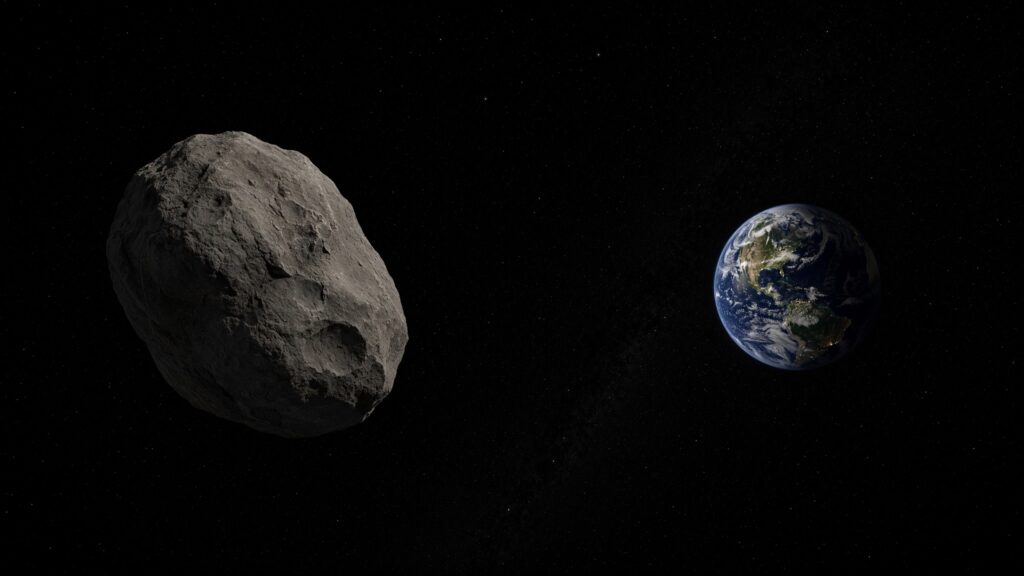
A tiny asteroid, designated 2026 QQ8, has entered Earth's orbit and could remain as our temporary minimoon until early 2027. This small asteroid, approximately six feet (2 meters) in diameter, was captured by Earth's gravity in April 2026 and is expected to depart sometime between late 2026 and early 2027. Earth's gravity temporarily binds such objects, only for the Sun's gravitational pull to eventually draw them away.
This phenomenon is known as a minimoon, and although it does not impact tides or the night sky, its discovery is significant. It suggests that Earth likely holds at least one minimoon at any given moment, with the advent of new telescopes making these hidden companions easier to detect. The asteroid was first observed by Hungarian astronomer Krisztian Sarneczky from the Piszkesteto Observatory in August 2026.
Its path was traced backwards, revealing that it crossed into Earth's Hill sphere in April, with a closest approach on May 1. Confirmation of its natural origin required observations from the University of Hawaii 2.2-meter telescope and the Lowell Discovery Telescope in Arizona, eliminating the possibility of it being artificial debris.
The asteroid's orbit closely mirrors Earth's, completing a loop around the Sun roughly every 359 days and passing by Earth about every 10 years at a distance of about 1.5 times the Moon's distance. Despite the misleading terminology, a true minimoon remains gravitationally bound to Earth, while a quasi-moon shares Earth's orbit around the Sun without being bound to us.
The distinction between the two is crucial. Examples of confirmed minimoons are scarce, with notable cases like 1991 VG and 2024 PT5, and quasi-moons like Kamoʻoalewa, a 40-meter asteroid, and 2025 PN7, which is expected to remain near Earth for approximately 60 years. The Vera C. Rubin Observatory, set to begin operations soon, is poised to revolutionize the discovery of minimoons by scanning the Southern Hemisphere sky every few days, potentially identifying numerous asteroids entering and leaving Earth's orbit over its planned 10-year survey.
Written by urgent.news from Colombia One's reporting — not their text. Machine-written — may contain errors; check the original before relying on it.