This featherweight, flying robot carries its own sensors and computers
The speedy microrobot flies without an attached motion-capture system, moving it closer to applications like agriculture or industrial surveillance.
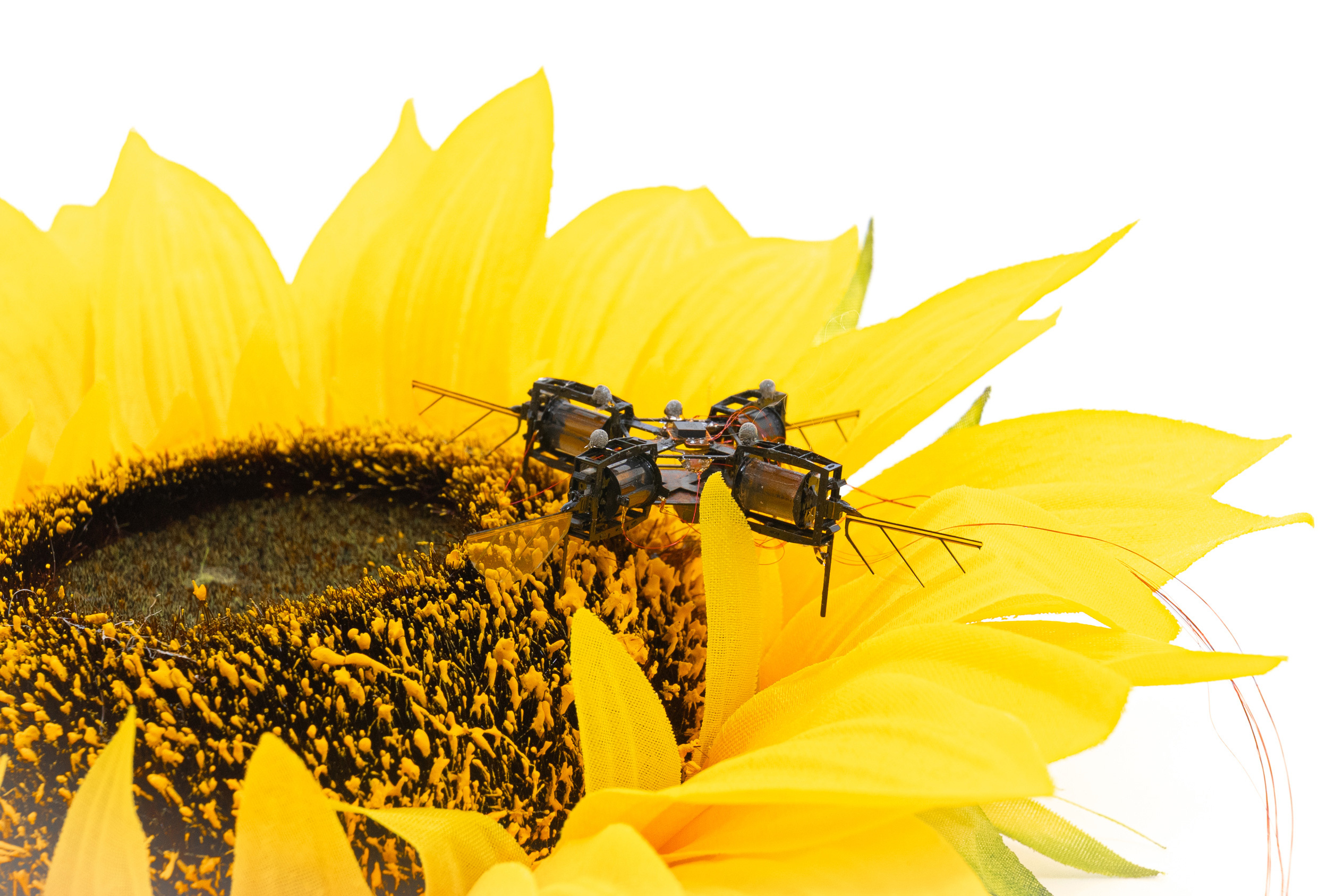
MIT researchers have created a tiny, drone-like robot capable of navigating independently. These lightweight flying machines, comparable in size to a microcassette, weigh less than a paperclip and boast bumblebee-like agility. Unlike previous models, this new design features onboard sensors and computation, enabling it to fly autonomously without external motion capture systems.
Developed by researchers at MIT's Electrical Engineering and Computer Science department, the robot's wings are powered by soft actuators, or artificial muscles, allowing it to execute complex maneuvers. To enable the robot to carry the necessary electronics for its autonomous functions, the team increased the size of the artificial muscles by 50%, while boosting the robot's lift force by 46%.
This resulted in a lift-to-weight ratio of 1.9, providing ample power to accommodate the robot's onboard electronics, which weigh only 244 milligrams.
The robot is equipped with an inertial measurement unit, an optical flow sensor, and a time-of-flight sensor for estimating position and orientation, enabling it to maintain stability during flight. The researchers optimized the sensor selection and position estimators to minimize drift and maintain high positional accuracy, similar to that achieved with offboard cameras.
Demonstrations showed the aerial microrobot successfully hovering at various heights and following point-to-point trajectories, with positional errors of just a few centimeters. MIT Associate Professor Kevin Chen, co-corresponding author of the paper, stated that this advancement marks a significant milestone in the research community, opening up new possibilities for aerial microrobots in tasks like precision agriculture and industrial surveillance where larger robots are impractical.
Written by urgent.news from MIT News AI's reporting — not their text. Machine-written — may contain errors; check the original before relying on it.
This story
This is one outlet's version. Read the fullest account.