From RAG to Riches: The Enterprise Blueprint for Building Production-Grade RAG
Discover how to build production-grade Retrieval-Augmented Generation (RAG) systems for your enterprise using no-code platforms and advanced data pipelines.
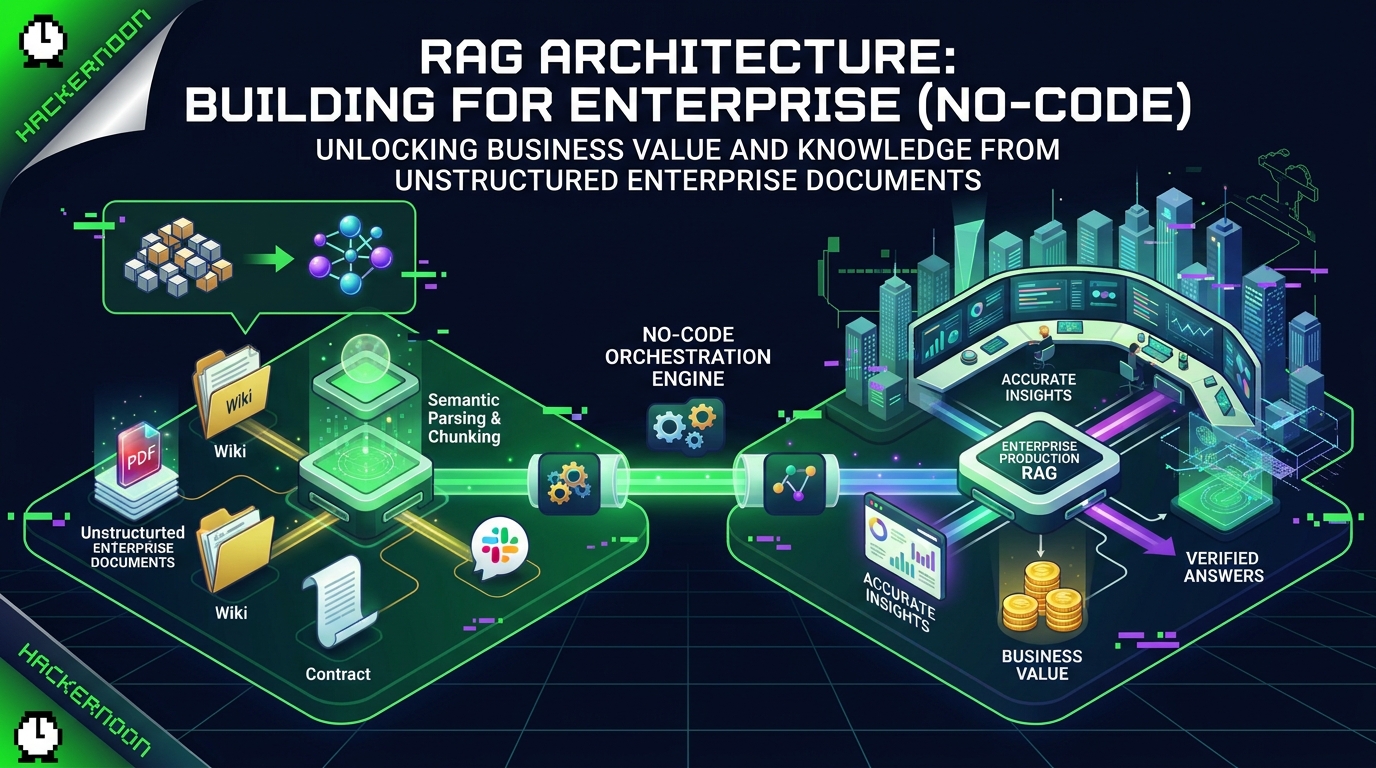
Building a production-grade Retrieval-Augmented Generation (RAG) system involves addressing several key issues that arise when adapting a naive RAG approach for real-world enterprise environments. The primary problems include the "Garbage In, Garbage Out" issue, ineffective chunking, lack of search capability, no access control, and inadequate generation. To tackle these challenges, a comprehensive blueprint for building a robust RAG system is presented.
The first step is to implement a Data Layout Parse Pipeline that utilizes advanced OCR and document intelligence tools. This pipeline cleans the data, identifies tables, and correctly formats the data, thereby eliminating junk text such as headers, footers, and random cells within tables. This prevents the database from becoming polluted with irrelevant information.
Another crucial aspect is to address the chunking issue. Basic systems typically chunk data by using a set number of characters, which can result in the loss of critical context. For instance, a table containing pricing information or a sentence with important policy information may be split in half, rendering the data useless. To overcome this problem, implement semantic or hierarchical chunking, which splits data based on natural changes in context, document headers, or sentences. This ensures that the data is split accurately and retains its original structure.
The next issue to tackle is the lack of search capability. Naive RAG systems only use vector similarity search, which often fails to find specific terms like error codes, part numbers, or policy clauses. To fix this, implement hybrid search and reranking. This combines vector search and traditional keyword search (BM25), allowing the system to find both the intent and specific IDs. A reranking algorithm then scores the results and returns the most accurate information.
Access control is another critical aspect of building a production-grade RAG system. Basic RAG systems place all corporate documents into a single large index, creating significant security concerns. An entry-level employee might ask the AI about company salaries or executive emails, leading to the return of sensitive data. To mitigate this risk, implement Document Level Access Control (ACLs) that checks the user's permissions to view corporate documents. This ensures that only authorized personnel can access specific documents.
During ingestion, it is essential to treat the knowledge base as a product and follow best practices for versioning, incremental ingestion, de-duplication, and verifiable deletion. Ensure you support multiple document types (PDF, DOCX, HTML, tables, and images) using structured parsing and OCR. Maintain comprehensive metadata, such as source, title, subheading, page number, date, access control list, and version number.
This structured approach ensures that the RAG system can efficiently search, filter, and retrieve relevant information.
Chunking strategy plays a significant role in the accuracy of the RAG system. Best practices recommend using recursive or structured chunking, with chunk sizes of 300-512 tokens and 50-100 tokens or 10-20% overlap for many enterprise corpora. Ensure that structure is retained in the data using parent/child chunking. For technical documents, avoid splitting code and explanations, and for legal or policy documents, ensure clauses are not split.
Only consider semantic or LLM chunking after measuring baseline performance with real question sets.
Hybrid retrieval and reranking provide significant gains in recall and precision, especially when dealing with queries that contain specific IDs, rare terms, or jargon. Use hybrid retrieval to obtain a larger candidate set, apply metadata filtering for access and freshness, and employ a cross encoder to rerank the top candidates. Adding reranking can yield meaningful improvements in accuracy with minimal latency increases.
Query understanding is vital for production systems. Not all queries should be treated the same, and production systems should use categorization/routing, expansion, multiple indexes/tools, and 'I don't know' scenarios. Implement light agent patterns for complex multi-hop or comparison queries, but only after the retrieval system performs well.
Ensure that grounded prompts are used to guarantee that the LLM only uses information from the provided context, and that citations are structured and traceable to the retrieved chunks.
Finally, focus on generation. Use grounded prompts to ensure the LLM only utilizes information from the provided context, and ask the LLM to cite sources. Implement input/output guardrails, PII and out-of-scope detection, and consider using multiple models. Prioritize cheaper/fast models for simple queries and powerful models for complex synthesis.
Audit the generated content and ensure that you have a golden set of real questions for evaluation. Monitor samples in production using LLM judge and manual checks, and ensure your pipeline is instrumented with distributed tracing for efficient debugging.
Written by urgent.news from HackerNoon's reporting — not their text. Machine-written — may contain errors; check the original before relying on it.