Extremely Accurate Measurements of a Pair of Flaring Red Dwarfs
Astronomers used the Very Large Baseline Array of radio telescopes to measure a pair of active red dwarfs with extreme precision. One of the stars is an extreme type of red dwarf called a Complex Periodic Variable. This is the first time one of these stars has been measured accurately in a binary system.
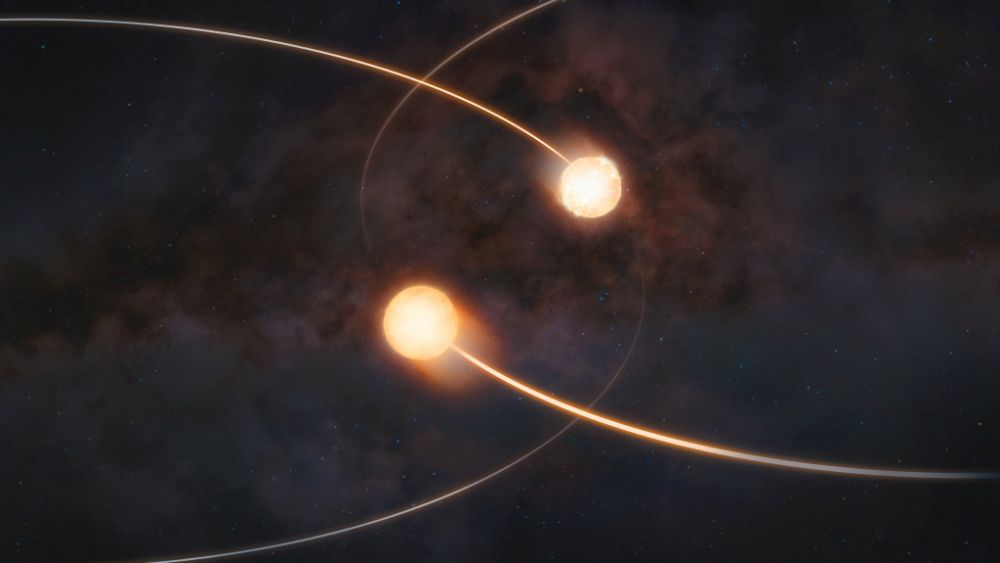
Located about 59 light years away, a binary system consisting of two red dwarf stars, called DG CVn, is orbiting a common center of mass. Unlike our Sun, these red dwarfs—M dwarfs—emit strong radio signals. A team of astronomers leveraged this property to conduct highly precise measurements of the binary pair, determining their orbits and masses with remarkable accuracy.
Red dwarfs, especially those in the M dwarf category, rotate rapidly during their youth due to inheriting angular momentum from their formation in gas clouds. This rapid spin generates powerful magnetic fields and results in intense stellar flares and large sunspots. Some young red dwarfs, known as Complex Periodic Variables (CPVs), display even more intricate light curves with sharp drops and multiple dips and peaks during a single rotation.
The binary system in question, DG CVn, includes one CPV star. Observations of these red dwarfs, spanning 18 years, were crucial in achieving the high level of precision. Utilizing the National Science Foundation’s Very Long Baseline Array (VLBA), a network of 10 radio telescopes spanning the USA, the astronomers monitored the stars' movements with extreme accuracy.
The VLBA, with its longest baseline of up to 8,611 km, allowed the researchers to detect the subtle reflex motions of the stars caused by their gravitational interaction. This method of astrometry through very long baseline interferometry (VLBI) proved essential in tracking the stars' paths and understanding their masses with extreme precision. The results, published in the journal Astronomy and Astrophysics, present the first dynamical mass measurement of a binary system containing a CPV star.
Written by urgent.news from Universe Today's reporting — not their text. Machine-written — may contain errors; check the original before relying on it.