Energie: Stromnetz am Limit – Städte müssen Industrieprojekte abweisen
Vielen deutschen Städten und Gemeinden fehlen nach Handelsblatt-Recherchen Stromnetzanschlüsse. Rechenzentren, Mobilfunk und Industrie müssen warten – Stillstände von mehr als zehn Jahren drohen.
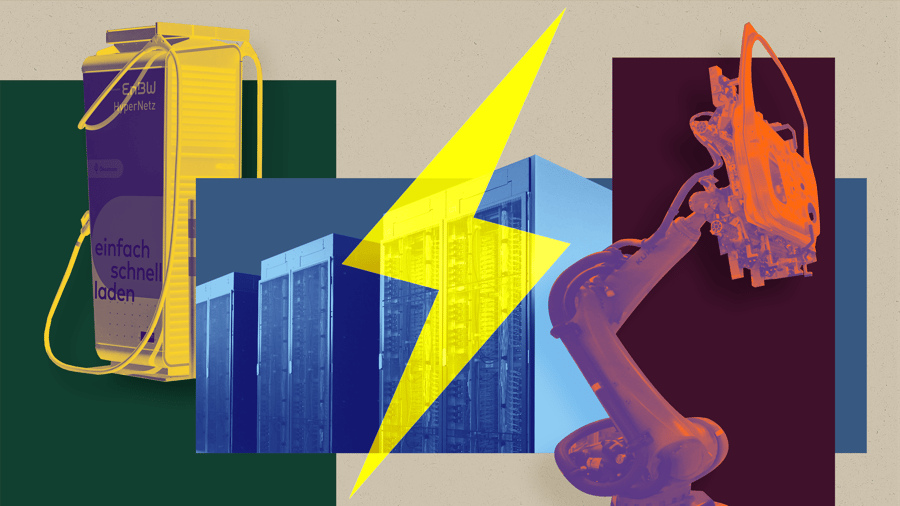
Deutschland's power grid is facing capacity limits, with energy companies informing businesses and politicians about widespread bottlenecks. Large consumers are being warned they may no longer be connected in the near future. Affected regions span across the country. A letter from EWE Netz, a North German energy firm, to all mayors and rural administrators in its network area details how many power supply connections could be "not realized or only with significant delays."
Building new grid capacity could "take at least ten years." Hamburg is experiencing a similar issue, with only 1.5 Megavoltampere (or 1.5 Megawatts) of additional capacity currently available. This compares to the power output of two electric vehicle charging stations.
The issue is particularly acute for EWE, Hamburg's energy networks, and E-Werk. Across the nation, municipal politicians, medium-sized business leaders, and corporate executives are complaining about a lack of grid connections. The consequences are severe: industrial projects are being turned away, construction projects are delayed by years, and the energy transition is being slowed.
In the German town of Rommerskirchen near Cologne, Bürgermeister Martin Mertens explains that the state's goal of phasing out brown coal by 2030 to create tens of thousands of jobs in AI, data processing, and green industry is not working out as planned. The plan to develop a modern industrial park on unused land next to a brown coal power plant was to create an emissions-free industrial park, generating jobs and facilitating structural change.
However, the project is stalled: the responsible grid operator has informed the municipality that a power supply for the new area will not be guaranteed by the middle of the 2030s. Mertens cites an example where a company wanted to align its CO2-neutral lorry fleet in a ten-truck charging operation, but the grid could not support this need, and the company was turned away. This is frustrating for Mertens.
The grid shortages are not only hindering company modernization but also efforts to reduce emissions. Klebestreifen manufacturer Tesa, led by Kourosh Bahrami, explains that its two production sites in Hamburg and Offenburg are experiencing concrete bottlenecks in the energy transition due to insufficient grid capacity. The company has been denied extensions for grid capacity, hindering its transition from fossil to renewable energy sources.
Bahrami believes that additional grid capacity will not be available for five years in Offenburg. Holger Klaassen, Senior Vice President for Energy and Climate at copper company Aurubis, warns that the situation in Hamburg is a significant concern for upcoming investment in industrial decarbonization.
Written by urgent.news from Handelsblatt's reporting — not their text. Machine-written — may contain errors; check the original before relying on it.
This story
This is one outlet's version. Read the fullest account.