Are Uranus and Neptune Secretly "Rock Giants"? A Noble Gas Might Hold the Answer
For decades, astronomers have divided the planets in the outer solar system into two distinct camps. Jupiter and Saturn were the “gas giants” made up primarily of hydrogen and helium. Uranus and Neptune were the “ice giants”, and were much smaller but were packed with heavier elements. A new paper from Olivier Mousis of the Southwest Research Institute and his co-authors, available in The…
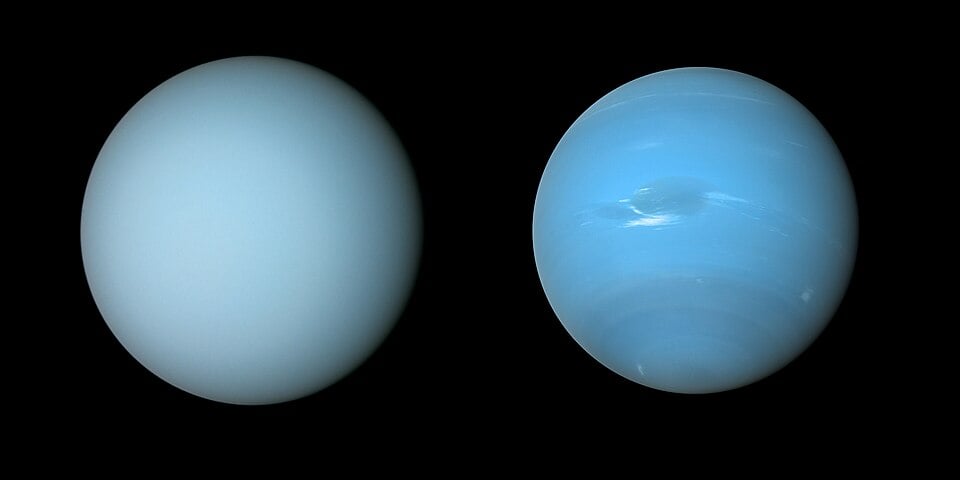
Recent research by a team led by Olivier Mousis of the Southwest Research Institute suggests that argon-40, a noble gas isotope, could be used to determine if Uranus and Neptune have hidden layers of rock beneath their thick, icy atmospheres. This isotope can reveal the presence of rock through its connection to potassium-40, which decays into argon-40.
On these ice giants, this process could have occurred when the planets initially formed, causing the noble gas to accumulate in their atmospheres from both volcanic activity and primordial sources. However, the origin of the argon-40 remains uncertain, as it could have stemmed from rocks or remnants from the protosolar nebula the planets formed from.
The concentration of argon-40 in the atmosphere could indicate whether these distant worlds have underlying rocky surfaces, but the answer hinges on the planets' formation location in relation to the "argon ice line." While the Uranus Orbiter and Probe mission, slated for launch in the 2040s, could help resolve this issue, the current level of uncertainty leaves room for further exploration and debate.
Written by urgent.news from Universe Today's reporting — not their text. Machine-written — may contain errors; check the original before relying on it.