An experimentally tested platform for skyrmion engineering
Researchers generate skyrmions, merons and related structures through moiré engineering The post An experimentally tested platform for skyrmion engineering appeared first on Physics World .
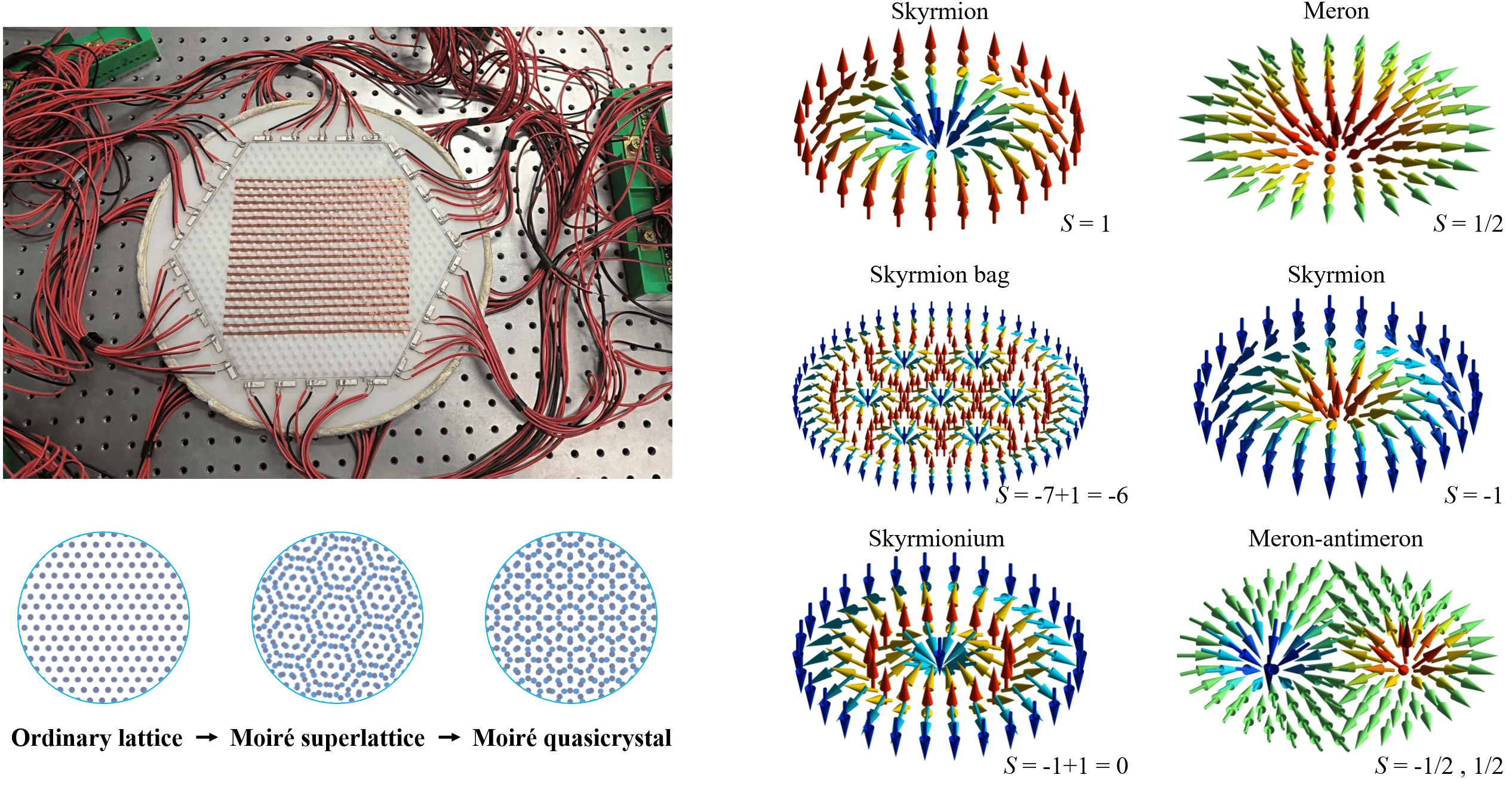
Researchers have developed an experimental platform capable of generating and manipulating a diverse range of skyrmion topological states, marking a significant advancement in the field of information storage and information transport. Skyrmions are stable patterns that emerge from fields such as magnetization within materials, exhibiting quasiparticle-like behavior. They are characterized by an array of vectors that twist in a specific manner, forming vortex-like patterns that resist destruction by small disturbances.
Traditionally, studies focused on generating a single skyrmion type at a time. However, this new approach utilizes two elastic wave layers stacked on top of each other and rotated relative to one another, creating an interference pattern known as a moiré pattern. By altering the twist angles between these layers, researchers can induce various topological wave structures, enabling the appearance, disappearance, coexistence, and transformation of different topological states.
The platform successfully produces skyrmions, merons (half-skyrmions), meron-antimeron pairs, skyrmion bags (multiple skyrmions enclosed within a larger structure), and skyrmioniums (ring-like structures with minimal net topological charge). At zero twist between the layers, regular lattices of skyrmions or merons are formed. As the twist angle increases to intermediate values, moiré superlattices emerge, supporting skyrmion bags.
At larger twists, around 30° or 45°, quasiperiodic patterns are observed, allowing for the coexistence of different topological states.
This research demonstrates a versatile experimental platform for creating and controlling a wide array of skyrmion topological states using moiré engineering in elastic-wave systems. Unlike previous methods that yielded a single skyrmion type, this approach offers a more comprehensive solution. The broader implications of this work include providing a robust experimental platform for designing topological wave states on demand, which could pave the way for future developments in wave-based information processing, programmable metamaterials, and topological devices.
Written by urgent.news from Physics World's reporting — not their text. Machine-written — may contain errors; check the original before relying on it.