Soil Water Content Determined by Elastic Wave Dispersion
Soil water content is a crucial parameter for the stability of civil engineering structures; estimating it by exploiting the dispersion of compressional waves now appears feasible.
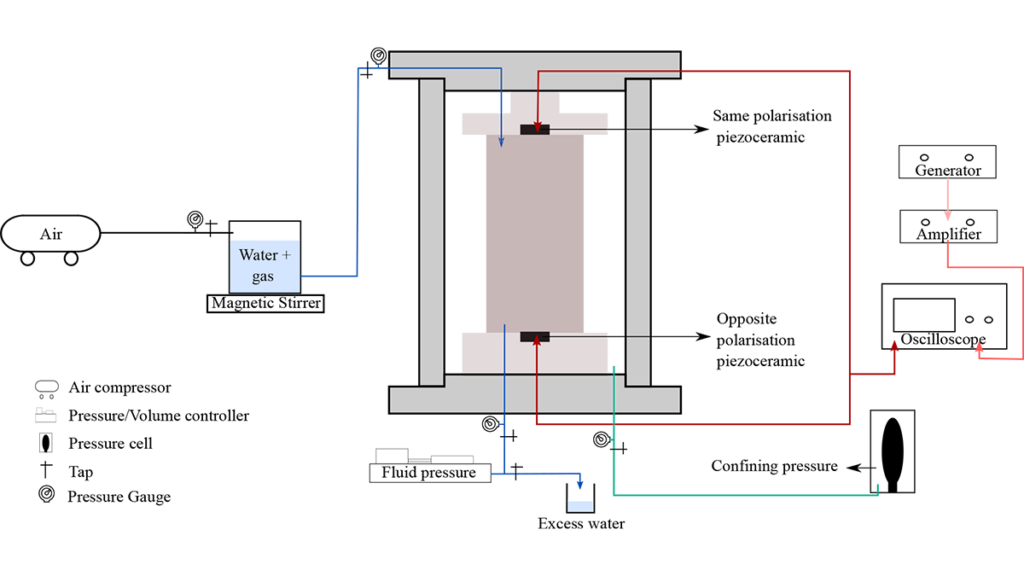
Researchers at AGU's Journal of Geophysical Research: Solid Earth have discovered a method to determine soil water content using elastic wave dispersion. This breakthrough is crucial as soil water content, typically unknown, significantly influences the effective mechanical properties of granular media, including soils.
The study, led by Flood-Page et al. [2026], introduces an innovative approach to estimate water content in soils by analyzing the frequency-dependent behavior of compressional wave velocities. The researchers interpret this velocity dispersion as a result of wave-induced fluid flow within water-saturated patches in the soil.
Their findings are grounded in rock physics theory, a field that has not been previously applied to soils. By applying this theory, Flood-Page and his colleagues effectively tackle a significant challenge in near-surface characterization. This research holds numerous potential applications, such as assessing the stability of building foundations and enhancing coastal and riverbank protection structures.
The work of Flood-Page et al. exemplifies a successful cross-disciplinary approach, integrating rock physics, soil science, and geotechnical engineering. Their study not only provides a novel solution to a long-standing problem in soil science but also opens up new avenues for research and practical applications in various engineering fields.
Written by urgent.news from Eos's reporting — not their text. Machine-written — may contain errors; check the original before relying on it.