Black Holes and Their Mysterious Bright Structures Explained
Black hole jets from the SMBH in Centaurus A, and from some other SMBH, are brighter on their edges than in their centers. It's called limb brightening, and it's unexpected, and astrophysicists want to know what causes it. They found their answer in detailed plasma physics simulations, and the results could also help efforts to develop fusion power.
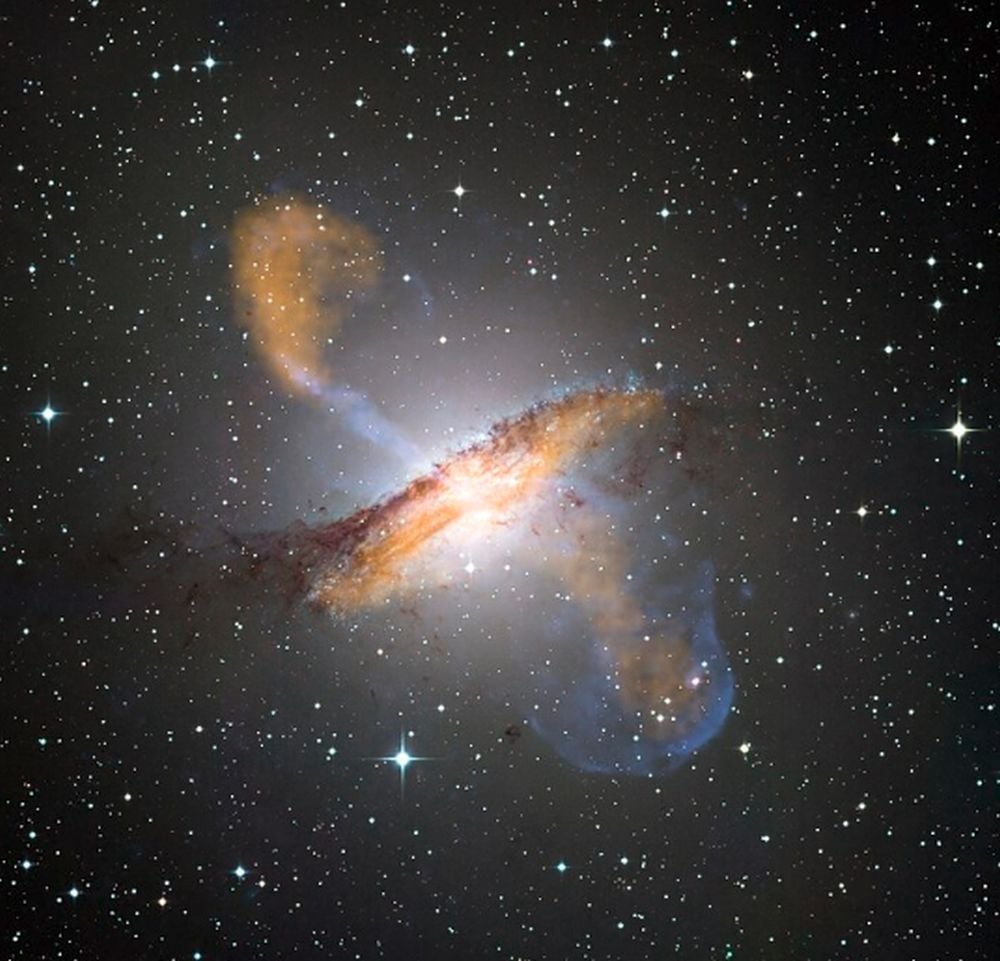
Supermassive black holes (SMBH) generate the most luminous astrophysical jets, which are long-lasting and visible across massive distances. These jets originate from active galactic nuclei (AGN), where a SMBH actively accretes matter. The process involves an accretion disk that rotates and heats up, leading to the ejection of material through powerful jets.
Although the mechanism behind these jets is not fully understood, astrophysicists know they are powered by the SMBH's rotational energy and strong magnetic fields, travel at speeds close to light, and release vast amounts of energy into the intergalactic medium, affecting star formation.
One puzzling aspect of these jets is their limb brightening, where the edges appear brighter than the center. Centaurus A, the closest radio galaxy to Earth, exhibits this phenomenon, making it an ideal natural laboratory for extreme physics. New research published in Astronomy and Astrophysics has proposed an explanation for this phenomenon.
The study, titled "Probing anisotropic particle acceleration and limb brightening in Centaurus A’s jet," focuses on the magnetohydrodynamic simulation of an accreting supermassive black hole and its jet launch. The lead author, Felix Glaser, a Master's student at the University of Würzburg in Germany, performed the simulation using the Event Horizon Telescope (EHT) observations.
The researchers observed that the electrons emitted in the jets do not have an even distribution of pitch angles, which is the angle between the magnetic field and each electron's velocity. This anisotropic particle distribution, combined with synchrotron radiation, is responsible for the observed limb brightening. Synchrotron radiation occurs when particles follow the curve of a magnetic field, and its emission is highly dependent on the pitch angle.
As a result, the observed brightness of the radiation changes based on the viewing angle of the magnetic field the particles are forced to follow. This groundbreaking research demonstrates that microscopic plasma effects can shape structures on vast scales, highlighting the importance of incorporating realistic plasma physics in future models.
Written by urgent.news from Universe Today's reporting — not their text. Machine-written — may contain errors; check the original before relying on it.